The Expansion History of the Universe
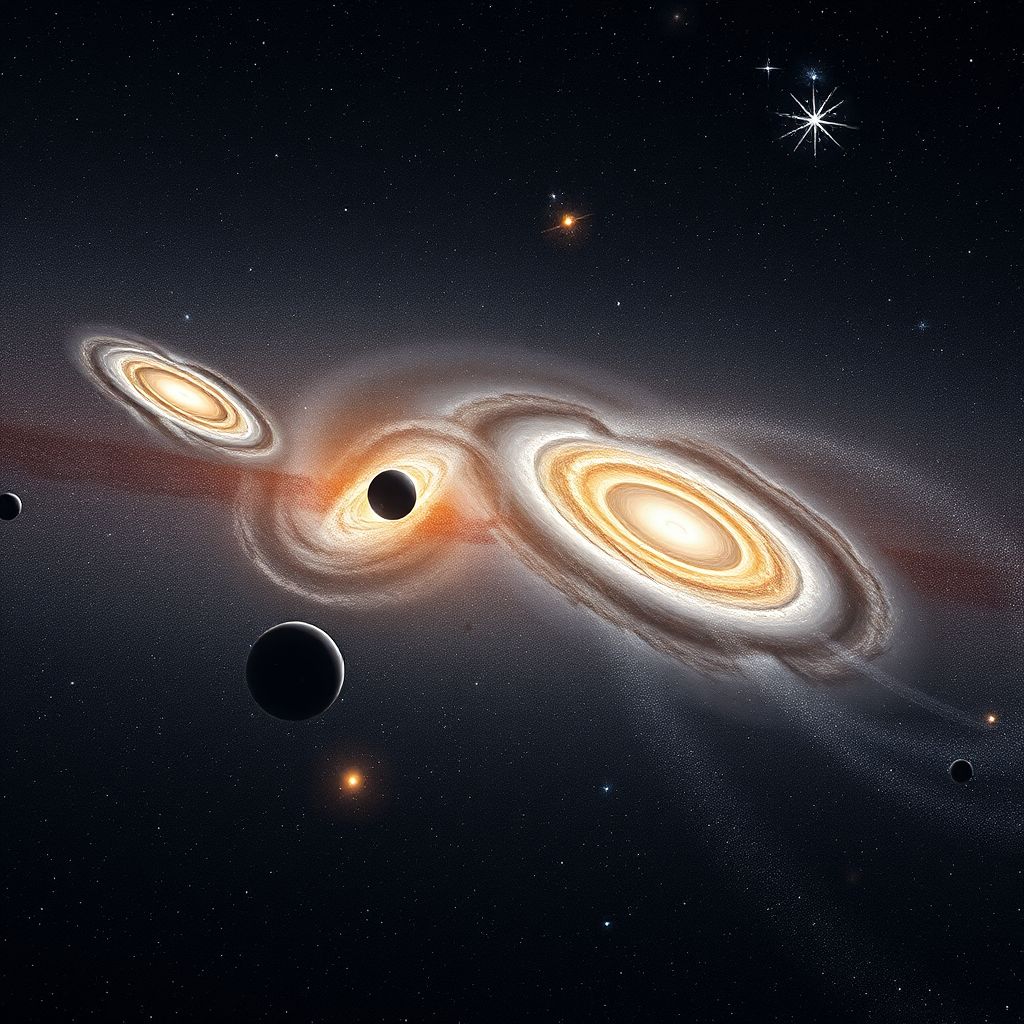
The Expansion History of the Universe has been a topic of fascination for astronomers and cosmologists alike since the early 20th century. The discovery that our universe is not static but expanding opened up new avenues for understanding the cosmos, leading to profound implications in physics, astronomy, and philosophy. This article delves into the rich history of cosmic expansion, from its initial detection through redshift observations to modern theories about dark energy and the ultimate fate of the cosmos.
The Expansion History of the Universe: An Overview
- Early Theories and Observations
- Edwin Hubble’s Breakthrough Discovery
- The Big Bang Theory Emerges
- Dark Matter and Dark Energy
- Current Understanding of Cosmic Expansion
- Future Prospects in Cosmology Research
- Conclusion: The Enduring Mystery of the Universe’s Expansion
Early Theories and Observations
The concept that the universe might be expanding was first proposed by the Russian mathematician Alexander Friedmann in 1922. He derived solutions to Albert Einstein’s field equations of general relativity, which suggested a dynamic universe rather than a static one as previously thought. However, it was Fritz Zwicky who independently made observations that hinted at cosmic expansion through his work on galactic clusters.
In the early years of the 20th century, many scientists believed in the Steady State Theory, which posited a static universe without beginning or end. This theory was popular because it avoided the philosophical and religious implications associated with a universe that had a finite age.
Observations Leading to Discovery
The key observation that would lead to the breakthrough came from the measurement of light emitted by distant galaxies. Astronomers noticed that this light was shifted towards longer wavelengths, known as redshift. This phenomenon suggested that these galaxies were moving away from us at high speeds.
Edwin Hubble’s Breakthrough Discovery
It was Edwin Hubble who finally established the relationship between a galaxy’s distance and its velocity in 1929. He discovered that more distant galaxies exhibit greater redshifts, indicating they are moving away faster than closer ones. This direct evidence for cosmic expansion became known as Hubble’s Law.
His findings were initially met with skepticism but eventually led to the widespread acceptance of an expanding universe theory.
The Big Bang Theory Emerges
The idea that the universe began in a highly dense and hot state, then expanded rapidly, was proposed independently by Georges Lemaître and later George Gamow. This theory offered a compelling explanation for the observed cosmic microwave background radiation discovered in 1965.
Origincosmic.com delves further into the origins of this pivotal discovery, which was confirmed as evidence supporting the Big Bang Theory and cementing our understanding of the universe’s evolution.
Implications for Cosmology
The acceptance of the Big Bang theory reshaped how we view not only our cosmic environment but also the fundamental laws governing it. It led to new questions about dark matter, dark energy, and the ultimate fate of the universe.
Dark Matter and Dark Energy
As scientists probed deeper into the cosmos, they encountered phenomena that could not be explained by existing theories—dark matter and dark energy. These mysterious components make up approximately 95% of the known universe’s mass-energy content.
- Dark Matter: Invisible material whose presence is inferred through gravitational effects on visible matter, radiation, and the large-scale structure of the cosmos.
- Dark Energy: A repulsive force causing the acceleration of cosmic expansion. Its exact nature remains one of the greatest mysteries in modern physics.
Challenges to Understanding Expansion
The discovery of dark energy through observations of distant supernovae in 1998 presented cosmologists with a perplexing conundrum: not only is the universe expanding, but this expansion is accelerating.
Current Understanding of Cosmic Expansion
Today, sophisticated technologies like space telescopes and ground-based observatories allow us to map out billions of galaxies across vast cosmic distances. This data has provided unprecedented insights into the structure and evolution of our universe.
- Cosmic Microwave Background (CMB): The afterglow radiation from the Big Bang, offering a window into early conditions in the cosmos.
- Baryon Acoustic Oscillations: A method used to measure distances in the universe by observing sound waves traveling through the early cosmos.
Advanced Tools and Techniques
The use of advanced cosmological models incorporating general relativity helps predict how matter should be distributed based on gravitational forces, aligning closely with observed data. This approach has refined our grasp of cosmic dynamics, even though many questions remain unanswered.
Future Prospects in Cosmology Research
As we look towards the future, promising developments include the development of new space missions and instruments designed to probe deeper into the universe’s structure and history. These advances promise significant breakthroughs in our understanding of dark matter and energy.
Technological Advancements
Investments in next-generation telescopes and observational platforms will enable astronomers to explore previously inaccessible regions, potentially revealing clues about the universe’s ultimate fate and the nature of its mysterious components.
Conclusion: The Enduring Mystery of the Universe’s Expansion
The Expansion History of the Universe is a testament to human ingenuity and perseverance in unraveling cosmic mysteries. From Hubble’s groundbreaking discovery to our current understanding involving dark matter and energy, each step forward has been marked by both clarity and new puzzles.
As we continue to push the boundaries of what is known about the cosmos, one thing remains clear: there are still vast territories left unexplored in the quest for a complete description of our universe’s origins and evolution. This ongoing journey into the unknown underscores why studying cosmology continues to be so compelling.

- OrginCosmic
- Interstellar Probes and the Future of Space Exploration March 27, 2026
- How Supernovae Shape Galaxy Evolution March 27, 2026
- Unexplained Transient Astronomical Events March 27, 2026
- The Role of Dark Energy in Cosmic Evolution March 27, 2026
- Vacuum Decay: A Doomsday Scenario for the Universe? March 27, 2026