Mini Black Holes and Their Theoretical Existence
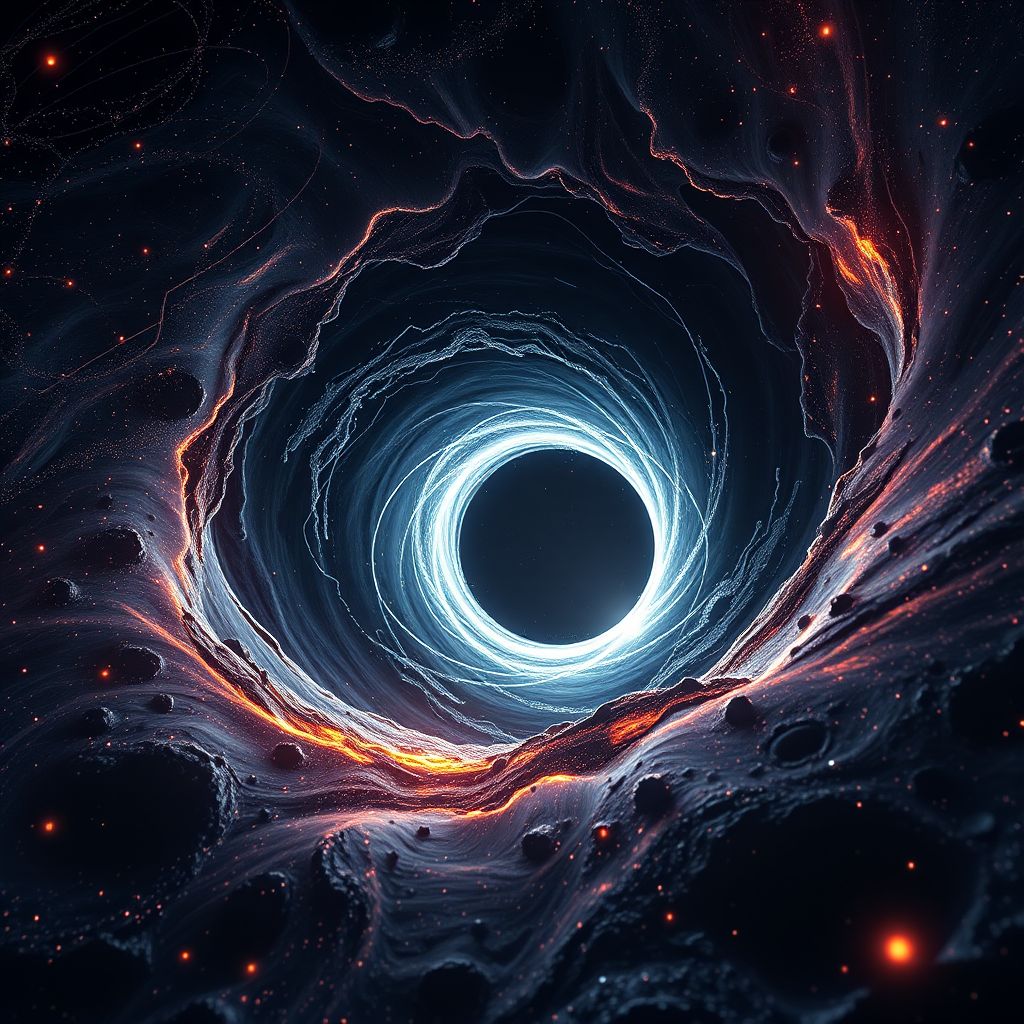
The concept of mini black holes and their theoretical existence has long fascinated scientists and cosmologists alike. These hypothetical celestial bodies are believed to have formed soon after the Big Bang, challenging our understanding of fundamental physics and opening up a realm of possibilities for scientific exploration. In this article, we will delve into the intricacies of mini black holes, discussing their formation, properties, potential impacts on astrophysics, and what they could mean for future research.
Introduction to Mini Black Holes and Their Theoretical Existence
The idea of mini black holes first emerged in the early days of quantum theory, offering a unique perspective on the nature of space-time. These objects are thought to be incredibly small, possibly even microscopic, with masses ranging from that of a speck of dust to that of a large asteroid. The theoretical existence of mini black holes is closely tied to the concept of extra dimensions and could provide insights into unifying general relativity with quantum mechanics.
Table of Contents
- Introduction to Mini Black Holes and Their Theoretical Existence
- The Concept of Mini Black Holes in Cosmology
- Formation Theories and Mechanisms
- Properties of Mini Black Holes
- Theoretical Existence Versus Observational Evidence
- Implications for Physics and Cosmology
- Exploring the Microscopic Universe Through Mini Black Holes
- Conclusion
The Concept of Mini Black Holes in Cosmology
The concept of mini black holes is deeply rooted in cosmological theories and provides a framework for understanding the early universe. These tiny singularities could have been produced during extreme conditions shortly after the Big Bang, where temperatures and densities were incredibly high. Theorized to be remnants from the initial moments of our cosmos, they offer insights into particle physics and the structure of space-time.
Mini Black Holes in the Early Universe
According to some models, mini black holes could have formed when the universe was just fractions of a second old. These conditions would have been hot enough to allow for the creation of particles with masses far exceeding those observed today. The potential for mini black hole formation is closely related to theories involving extra dimensions and the possibility that our observable universe exists in only three spatial dimensions.
The Role of Mini Black Holes in Cosmology
Mini black holes play a crucial role in cosmological studies, particularly in examining the early stages of the universe. They are considered to be one of the few ways scientists might observe the effects of extra dimensions and test theories about quantum gravity. Understanding these objects could lead to significant breakthroughs in our comprehension of cosmic events like the Big Bang.
Formation Theories and Mechanisms
The formation of mini black holes is a complex process involving high-energy collisions or extreme gravitational conditions. Scientists propose several mechanisms for their creation, each with unique implications for our understanding of the universe.
The Collision Theory
One prominent theory suggests that mini black holes form from the collision and subsequent merger of ultra-high-energy cosmic rays or particles in high-energy collisions. This process could occur near cosmic accelerators such as gamma-ray bursts or quasars, where conditions are ripe for such phenomena.
Gravitational Collapse Theory
Another theory involves gravitational collapse under extreme pressure and density conditions in the early universe. The rapid cooling of plasma after the Big Bang could have caused some regions to become so dense that they collapsed into mini black holes.
Properties of Mini Black Holes
Mini black holes possess several unique properties that set them apart from their larger counterparts. These characteristics include an extremely small radius, a high surface gravity, and the potential for Hawking radiation to be significant enough to observe.
Size and Mass of Mini Black Holes
The size of mini black holes is incredibly minuscule, typically on the order of Planck length (approximately \(10^{-35}\) meters). Despite their small size, they can have masses ranging from subatomic particles to larger entities like planets or moons. This mass range allows for a variety of potential observational scenarios.
Hawking Radiation
One of the most intriguing aspects of mini black holes is their potential to emit Hawking radiation at detectable levels. Unlike larger black holes, where this emission would be too weak to observe, mini black holes could radiate enough energy to potentially be detected by advanced telescopes.
Theoretical Existence Versus Observational Evidence
While the theoretical existence of mini black holes is well-established in physics literature, observational evidence remains scarce. The challenge lies in detecting such tiny objects against a backdrop of numerous other cosmic phenomena.
Current Challenges in Detection
The detection of mini black holes poses significant challenges due to their small size and the limitations of current observational technology. Scientists are continually developing new methods and instruments aimed at overcoming these obstacles, including the use of advanced particle detectors and gravitational wave observatories.
Future Prospects for Observation
Advancements in technologies such as quantum sensors and high-energy particle accelerators could offer promising avenues for detecting mini black holes. Additionally, future space missions might provide opportunities to observe the effects of these objects on cosmic rays or other astronomical phenomena.
Implications for Physics and Cosmology
The study of mini black holes has profound implications for both physics and cosmology. Understanding their properties could lead to breakthroughs in theoretical frameworks, testing the limits of our current models of space-time.
Testing the Limits of Quantum Mechanics
Mini black holes offer a unique laboratory for probing the boundaries between general relativity and quantum mechanics. By studying these objects, scientists hope to uncover new insights into how these two fundamental theories might be reconciled.
Cosmological Insights
The potential existence of mini black holes provides clues about the early universe and its evolution over time. Their detection could shed light on phenomena such as dark matter, cosmic inflation, and the formation of large-scale structures in the cosmos.
Exploring the Microscopic Universe Through Mini Black Holes
Mini black holes serve as a bridge between macrocosmic observations and microscopic quantum phenomena, offering unparalleled opportunities for scientific exploration.
Bridging Quantum and Cosmological Scales
The study of mini black holes allows researchers to explore how processes at the subatomic level influence events on cosmological scales. This interdisciplinary approach could lead to novel theories that unify different aspects of physics.
Probing the Universal Structure
Understanding mini black holes can provide insights into the structure and evolution of the universe as a whole. By investigating these tiny singularities, scientists hope to unravel some of the most profound mysteries of our cosmos.
Conclusion
The exploration of mini black holes and their theoretical existence continues to be a captivating field within astrophysics and cosmology. Despite the challenges in detection, these objects hold immense potential for advancing our understanding of fundamental physics and the universe’s origins. As research progresses, mini black holes may well become key players in shaping future scientific endeavors.
For further reading on similar topics and detailed explorations into cosmic phenomena, visit Origin Cosmic.
To learn more about the financial implications of such groundbreaking discoveries or for general information on physics news, you can refer to reputable sources like Wikipedia’s Black Hole page which offers comprehensive and up-to-date information.

- OrginCosmic
- Interstellar Probes and the Future of Space Exploration March 27, 2026
- How Supernovae Shape Galaxy Evolution March 27, 2026
- Unexplained Transient Astronomical Events March 27, 2026
- The Role of Dark Energy in Cosmic Evolution March 27, 2026
- Vacuum Decay: A Doomsday Scenario for the Universe? March 27, 2026