What Powers Active Galactic Nuclei?
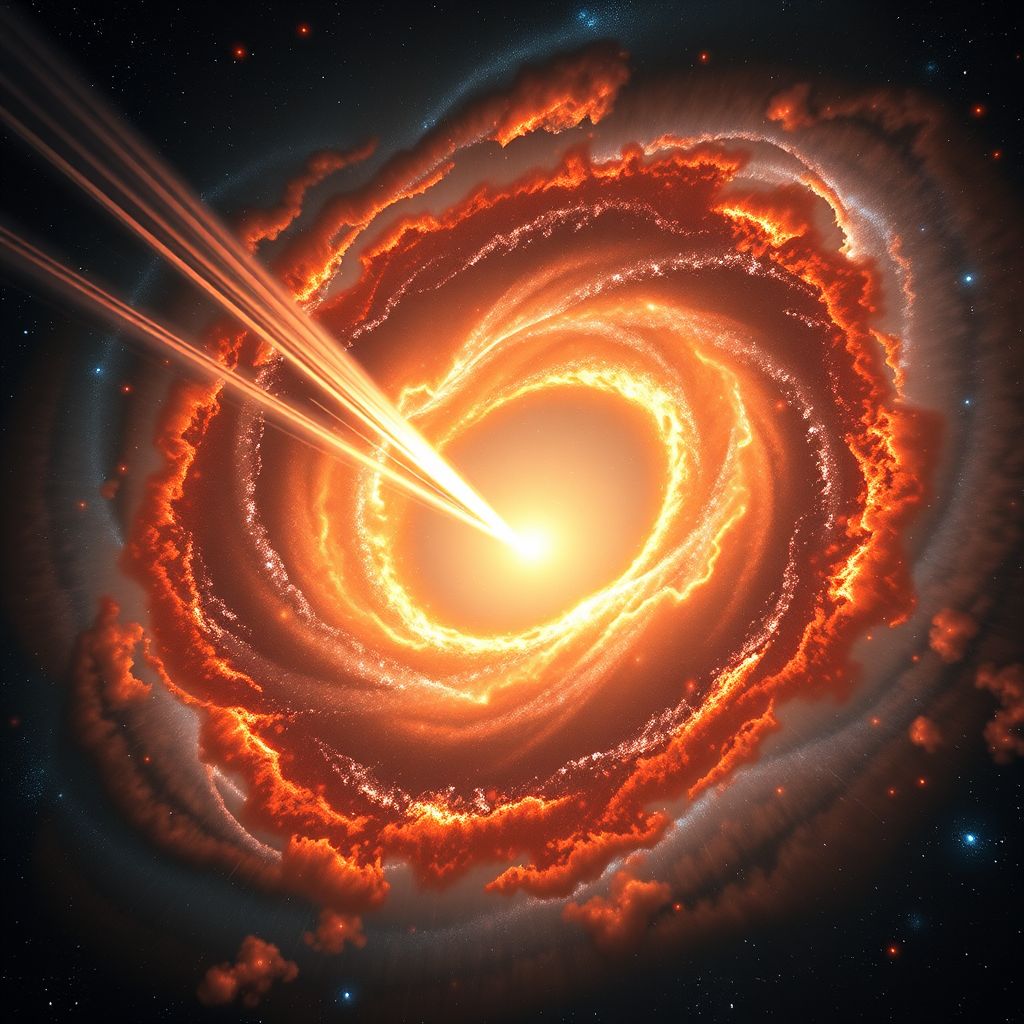
Understanding the enigmatic power source of Active Galactic Nuclei (AGNs) remains one of the most compelling questions in modern astrophysics, captivating scientists around the world. What Powers Active Galactic Nuclei? This question not only drives curiosity but also fuels groundbreaking research into the mechanisms that govern some of the universe’s most energetic phenomena.
- What Are Active Galactic Nuclei?
- What Powers Active Galactic Nuclei? The Central Black Hole Hypothesis
- The Role of Accretion Disks in AGNs
What Are Active Galactic Nuclei?
An Active Galactic Nucleus (AGN) is a compact region at the center of some galaxies that emits intense electromagnetic radiation. This region is powered by an extremely massive black hole, which can be billions of times more massive than our Sun. AGNs are characterized by their enormous luminosity across multiple wavelengths and often exhibit powerful jets and strong radio emissions. The energy released from these systems can outshine the combined light of all stars in their host galaxies.
What Powers Active Galactic Nuclei? The Central Black Hole Hypothesis
The central black hole hypothesis is the leading explanation for what powers AGNs. According to this model, the energy output from an AGN comes primarily from matter falling into a supermassive black hole at the galaxy’s center. As gas and dust approach the black hole, they form a hot accretion disk around it due to frictional forces. This process releases enormous amounts of gravitational potential energy as material spirals inward towards the event horizon.
The Role of Accretion Disks in AGNs
Accretion disks are crucial components in understanding what powers active galactic nuclei. These rotating disks of gas and dust orbit around a central black hole, gradually feeding it with matter. The intense gravitational forces and friction within the disk generate immense heat and radiation. This process is responsible for much of the luminosity observed from AGNs.
Understanding Emission Mechanisms in AGNs
The emission mechanisms associated with active galactic nuclei are diverse and complex, involving various physical processes that occur within their highly energetic environments. For instance, synchrotron radiation is a significant source of radio emission from AGNs, where charged particles accelerated to relativistic speeds emit electromagnetic waves.
Pro Tip: Analyzing Spectral Lines
Spectral lines provide key insights into the physical conditions within an AGN. By studying these lines, astronomers can determine temperature, density, and ionization state of gas clouds surrounding the central black hole, offering clues to the energy release mechanisms.
The Impact of Jets on the Surrounding Environment
AGNs often produce powerful jets that extend far beyond their host galaxies. These jets are highly collimated streams of plasma moving at nearly the speed of light and can significantly influence the surrounding intergalactic medium. The impact of these jets includes heating, compressing, and ionizing gas clouds in nearby space.
Case Study: M87’s Jet
The galaxy Messier 87 (M87) is famous for its prominent radio jet extending thousands of light-years from its central black hole. Observations have shown that this jet interacts strongly with the interstellar medium, creating shock waves and enhancing star formation in nearby regions.
Observational Evidence for AGN Power Sources
Various observational techniques have provided strong evidence supporting the theory of what powers active galactic nuclei. X-ray observations reveal hot gas near supermassive black holes, indicating intense accretion activity. Additionally, infrared and optical spectroscopy studies show broad emission lines indicative of high-speed rotating disks around central engines.
Current Research and Future Prospects
Recent advancements in observational astronomy continue to refine our understanding of AGNs. For example, the Event Horizon Telescope (EHT) collaboration has captured direct images of the shadow of a black hole in M87, providing unprecedented insights into accretion processes near supermassive objects.
Pro Tip: Integrating Multi-Wavelength Observations
A comprehensive approach to studying AGNs involves integrating data from multiple wavelength bands. This technique allows researchers to piece together the full picture of an AGN’s energy output and its effects on surrounding environments.
Conclusion
In summary, understanding what powers active galactic nuclei is critical for advancing our knowledge about galaxy evolution and high-energy astrophysics. While significant progress has been made through observational studies, there remains much to explore. As technology continues to improve, expect further breakthroughs that will shed new light on these fascinating cosmic phenomena.
For more in-depth exploration of astronomical concepts like AGNs, consider visiting OriginCosmic, a leading resource for cosmic enthusiasts and professionals alike. Additionally, the scientific community frequently reports updates on this topic through reputable sources such as NASA’s Universe Exploration Division.

- OrginCosmic
- Interstellar Probes and the Future of Space Exploration March 27, 2026
- How Supernovae Shape Galaxy Evolution March 27, 2026
- Unexplained Transient Astronomical Events March 27, 2026
- The Role of Dark Energy in Cosmic Evolution March 27, 2026
- Vacuum Decay: A Doomsday Scenario for the Universe? March 27, 2026