Tidal Disruption Events: Stars Torn Apart by Black Holes
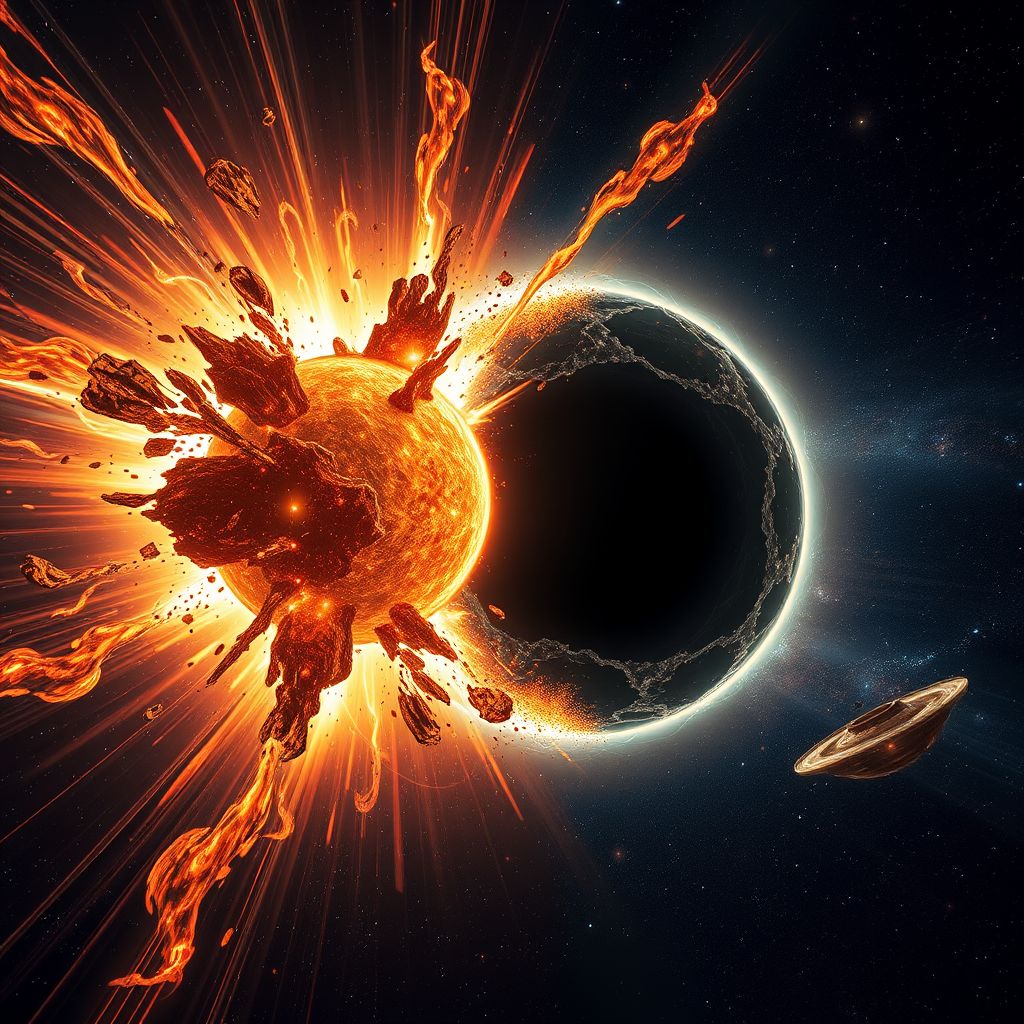
Tidal Disruption Events: Stars Torn Apart by Black Holes are fascinating astronomical occurrences that reveal critical insights into the nature of black holes and their interactions with surrounding stellar objects. These events, characterized by a star’s close encounter with a supermassive black hole leading to its destruction, offer a unique perspective on the dynamics between celestial bodies in our universe. This article delves deep into understanding Tidal Disruption Events, exploring their mechanisms, observations, and implications for astrophysics.
- Understanding Tidal Disruption Events: Stars Torn Apart by Black Holes
- Mechanisms Behind Tidal Disruption Events
- Observations and Detection Methods
- Case Studies of Notable Tidal Disruption Events
- Theoretical Models and Simulations
- Implications for Astrophysics Research
- Challenges in Studying Tidal Disruption Events: Stars Torn Apart by Black Holes
- Future Prospects and Technological Advancements
Understanding Tidal Disruption Events: Stars Torn Apart by Black Holes
Tidal Disruption Events (TDEs) occur when a star ventures too close to the gravitational pull of a supermassive black hole, leading to its destruction. The tidal forces exerted by the black hole stretch and compress the star until it is torn apart. This process results in significant flares of electromagnetic radiation, making TDEs detectable across vast cosmic distances.
The stellar material that survives the disruption forms an accretion disk around the black hole. As this debris spirals into the black hole, intense X-ray emissions and optical light are produced, providing astronomers with valuable data to study these extraordinary events.
Mechanisms Behind Tidal Disruption Events
The mechanisms behind TDEs involve intricate gravitational dynamics. When a star passes within the tidal radius of a black hole, tidal forces cause dramatic elongation and compression of the stellar body. The strength of these forces depends on the mass and distance of both the star and the black hole.
Gravitational Forces and Tidal Radius
The gravitational force experienced by an object decreases with increasing distance from a massive body, but tidal forces increase as you get closer to the center. For stars orbiting near supermassive black holes, these forces can be strong enough to rip apart the star well before it reaches the event horizon of the black hole.
Star Destruction and Matter Ejection
The star’s destruction begins with tidal stripping, where material is pulled away from the stellar body. This ejected matter then forms an accretion disk around the black hole, leading to intense radiation emissions that are observable across space. Understanding these mechanisms helps researchers infer properties of both the stars and black holes involved.
Observations and Detection Methods
Observing Tidal Disruption Events requires advanced telescopic instruments capable of capturing high-energy emissions. These events are rare, but with improved observational techniques and broader sky coverage, scientists have recorded more instances over recent years.
Radiation Spectroscopy
TDEs produce a wide range of electromagnetic radiation, from X-rays to optical light. By analyzing the spectrum of these emissions, researchers can determine properties such as temperature, velocity, and composition of the ejected material.
Gravitational Wave Detection
In some cases, TDEs may generate gravitational waves detectable by instruments like LIGO and Virgo. While direct detection is challenging due to their rare occurrence, theoretical studies suggest that future advancements in gravitational wave astronomy could provide additional insights into these events.
Case Studies of Notable Tidal Disruption Events
Several well-documented instances highlight the significance and variability of TDEs. One such event was ASASSN-14li, discovered in 2014 near the center of galaxy PGC 043234 at a distance of about 290 million light-years away.
ASASSN-14li
This TDE showed an unusually bright flare that lasted several months, offering detailed observational data crucial for understanding stellar disruption and black hole behavior. Observations from multiple wavelengths confirmed the presence of both a rapidly spinning black hole and high-speed jets associated with the event.
Theoretical Models and Simulations
Simulating TDEs provides insights into their complex physical processes, enabling researchers to predict characteristics of undetected events. These simulations use sophisticated algorithms to model gravitational interactions, matter accretion, and radiation emission.
Numerical Modeling Techniques
Computational methods such as smoothed-particle hydrodynamics (SPH) allow for detailed modeling of gas dynamics in the vicinity of black holes. By incorporating realistic stellar profiles and black hole properties, these simulations can accurately reproduce observed phenomena.
Implications for Astrophysics Research
Tidal Disruption Events have profound implications for astrophysical studies ranging from black hole demographics to star formation in galactic centers. They provide unique opportunities to study the extreme conditions and physical processes occurring near supermassive black holes.
Black Hole Demographics
By analyzing TDE frequency, researchers can estimate the number of dormant or hidden black holes in galaxies, thereby refining models for black hole growth and evolution throughout cosmic history.
Challenges in Studying Tidal Disruption Events: Stars Torn Apart by Black Holes
Despite significant advancements, several challenges remain in the study of TDEs. One major issue is the rarity of these events combined with their transient nature, making continuous monitoring essential yet difficult to achieve.
Future Prospects and Technological Advancements
The future of studying Tidal Disruption Events holds promise for improved observational capabilities and theoretical understanding. Upcoming missions like the James Webb Space Telescope (JWST) will provide unprecedented views into these events, enhancing our comprehension of cosmic phenomena.
As we continue to unravel the mysteries surrounding Tidal Disruption Events: Stars Torn Apart by Black Holes, it becomes evident that these rare and dramatic occurrences play a crucial role in advancing astrophysical research. From refining our understanding of black hole demographics to probing extreme physical conditions, the study of TDEs continues to be an exciting frontier in modern astronomy.

- OrginCosmic
- Interstellar Probes and the Future of Space Exploration March 27, 2026
- How Supernovae Shape Galaxy Evolution March 27, 2026
- Unexplained Transient Astronomical Events March 27, 2026
- The Role of Dark Energy in Cosmic Evolution March 27, 2026
- Vacuum Decay: A Doomsday Scenario for the Universe? March 27, 2026