The Reionization Era of the Early Universe
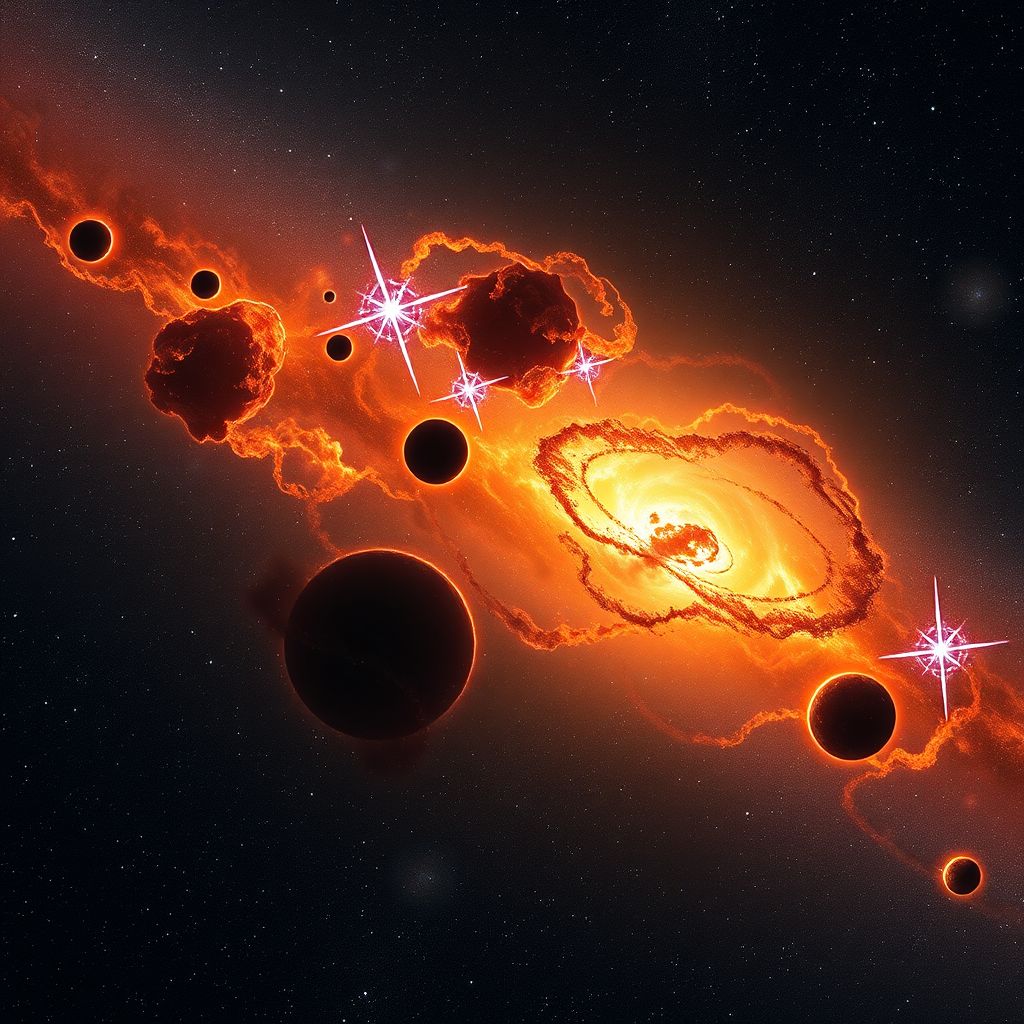
Understanding The Reionization Era of the Early Universe requires delving into the profound mysteries that underpin our cosmic origins. This era, which occurred approximately 380,000 to a billion years after the Big Bang, is a critical phase in cosmological history where the universe transitioned from its opaque state back to transparency through intense ultraviolet radiation emitted by the first stars and quasars.
Introduction
Exploring The Reionization Era of the Early Universe, we aim to illuminate this pivotal period that marked a transformation in cosmic evolution. This era, while challenging to observe directly due to its distance and age, offers invaluable insights into how matter and energy interacted shortly after the universe’s birth.
Table of Contents
- Introduction
- The Cosmic Timeline: From Dark Ages to Reionization
- Causes and Mechanisms of Reionization
- Observational Techniques in Studying the Reionization Era
- Recent Findings and Breakthroughs
- Challenges and Future Research Directions
- Theoretical Models of Reionization Era
- Conclusion
The Cosmic Timeline: From Dark Ages to Reionization
The cosmic timeline is a vast, intricate narrative that begins with the Big Bang and extends into the present day. The period following the universe’s initial expansion was dominated by an era known as the “Dark Ages,” characterized by neutral hydrogen atoms filling space without sufficient radiation for ionized plasma to form. During this time, matter cooled and gravitationally collapsed into dense regions, eventually leading to the formation of the first stars and galaxies.
As these early luminous objects ignited, they emitted intense ultraviolet radiation that began to break apart neutral hydrogen atoms, initiating The Reionization Era of the Early Universe. This process gradually spread through space until it permeated the entire universe, marking a significant shift in its composition and energy state.
Period of Cosmic Blackout: The Dark Ages
Before reionization, the universe was an opaque fog due to neutral hydrogen atoms absorbing radiation. This era is referred to as the “Dark Ages” because there were no sources of light until the first stars and quasars formed.
Causes and Mechanisms of Reionization
The mechanisms driving reionization are complex, involving both radiation from early star formation and energetic processes within galaxies. Intense ultraviolet photons emitted by the first stars and quasars provided the energy necessary to ionize hydrogen atoms, leading to transparency.
Early Stars and Quasars: Key Players in Reionization
Stars and quasars were instrumental in initiating reionization. These celestial bodies emit high-energy radiation that breaks apart neutral hydrogen into protons and electrons, effectively clearing the intergalactic medium.
Observational Techniques in Studying the Reionization Era
Studying The Reionization Era of the Early Universe presents unique challenges due to its great distance and age. However, several observational techniques are employed by astronomers:
Cosmic Microwave Background (CMB) Measurements
CMB observations provide crucial insights into the universe’s conditions before reionization.
Quasar Lyman Alpha Emission Lines
Lyman alpha emission lines from distant quasars offer a way to trace hydrogen clouds and their ionized state.
Recent Findings and Breakthroughs
Advancements in telescope technology have led to significant breakthroughs, including the discovery of galaxies at redshifts greater than 7. These distant observations are crucial for understanding reionization dynamics and timelines.
Latest Telescope Observations: Key Discoveries
Telescopes like ALMA and Hubble have made pivotal contributions to our understanding of the early universe, providing detailed insights into galaxy formation during reionization.
Challenges and Future Research Directions
Much remains unknown about The Reionization Era of the Early Universe, making it a fertile ground for future research. Ongoing projects aim to refine our models and observational techniques, pushing the boundaries of cosmic knowledge.
Upcoming Telescopes: Enhancing Our Understanding
Next-generation telescopes such as James Webb will offer unprecedented clarity into early galaxy formation and reionization processes.
Theoretical Models of Reionization Era
Theoretical frameworks are essential for predicting the behavior of matter during reionization. These models incorporate various parameters to simulate cosmic conditions accurately, aiding in empirical verification through observations.
Cosmological Simulations: Key Concepts and Applications
Sophisticated simulations are used to replicate early universe scenarios, allowing scientists to test hypotheses and refine theories regarding reionization.
Conclusion
Understanding The Reionization Era of the Early Universe is crucial for unraveling the mysteries surrounding our cosmic origins. Through a combination of observational astronomy, theoretical modeling, and technological advancements, we continue to gain valuable insights into this transformative period in the universe’s history.
Origins Cosmic offers extensive resources on cosmological topics, including detailed articles about reionization.

- OrginCosmic
- Interstellar Probes and the Future of Space Exploration March 27, 2026
- How Supernovae Shape Galaxy Evolution March 27, 2026
- Unexplained Transient Astronomical Events March 27, 2026
- The Role of Dark Energy in Cosmic Evolution March 27, 2026
- Vacuum Decay: A Doomsday Scenario for the Universe? March 27, 2026