Could We Terraform Mars or Other Planets?
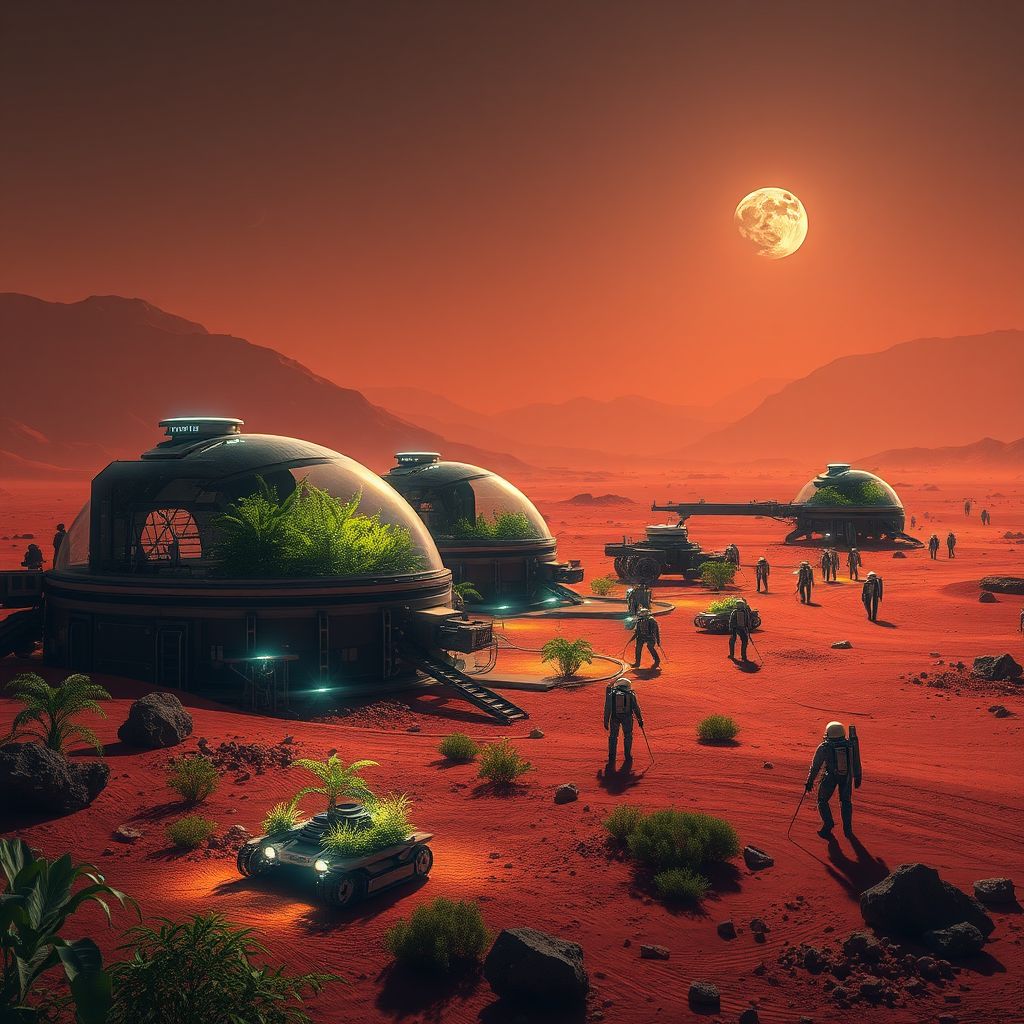
Could we terraform Mars or other planets? This question has intrigued scientists, engineers, and dreamers for decades, as humanity looks towards the stars with a growing interest in space exploration and colonization. The concept of terraforming—essentially altering a planet’s environment to make it more habitable for humans—is not just a theoretical exercise; it represents one of the most ambitious endeavors we could undertake in our quest to explore and settle new worlds.
Table of Contents
- Introduction to Terraforming Mars or Other Planets
- The Challenges of Terraforming Mars or Other Planets
- Understanding the Environmental Conditions on Mars
- Technological Advancements in Space Exploration
- Current Research and Initiatives for Terraforming Planets
- Potential Benefits of Terraforming Mars or Other Planets
- Ethical Considerations in Terraforming Efforts
- The Future Outlook for Terraforming Mars or Other Planets
Introduction to Terraforming Mars or Other Planets
The idea of terraforming Mars has captivated the imagination since the early days of space exploration. The concept revolves around transforming a planet’s atmosphere, temperature, and other environmental factors to create conditions that could support human life without the need for extensive protective gear and habitats. While the notion sounds straightforward in theory, the actual implementation presents enormous challenges.
Current State of Research
Terraforming Mars or other planets is not a new idea. It was first proposed by science fiction writers like Ray Bradbury and Kim Stanley Robinson, who imagined lush Martian landscapes filled with vegetation and water bodies. Scientifically, the concept gained traction in the 1970s as researchers began to explore the possibilities of altering planetary atmospheres through artificial means.
Why Mars?
Mars has been a focal point for terraforming research due to its proximity to Earth and similarity in composition. It possesses polar ice caps containing water, an atmosphere with trace amounts of gases necessary for human life (like carbon dioxide), and geologic evidence suggesting the presence of flowing liquid water in ancient times.
The Challenges of Terraforming Mars or Other Planets
Terraforming Mars or other planets faces an array of technical and logistical hurdles. The most significant challenge is altering the Martian atmosphere, which is currently too thin to sustain human life without substantial intervention.
Atmospheric Alteration
To terraform Mars, one would need to thicken its atmosphere significantly to increase atmospheric pressure and warmth. This could be achieved by releasing gases stored in subsurface deposits or utilizing artificial means such as solar reflectors to induce a greenhouse effect. However, the amount of gas needed far exceeds current technological capabilities.
Temperature Control
Mars experiences extreme temperature fluctuations, with daytime highs near freezing and night-time lows that can drop well below -100°C (-148°F). Maintaining stable temperatures across vast planetary surfaces poses a significant challenge. Advanced climate control systems would be required to moderate these variations.
Understanding the Environmental Conditions on Mars
Mars presents unique environmental challenges that must be overcome for terraforming endeavors. Its atmosphere is composed primarily of carbon dioxide, with a surface pressure less than 1% that of Earth’s sea level.
Polar Ice Caps
The Martian polar ice caps contain vast reserves of water in the form of ice and permafrost. Unlocking these resources would be crucial for providing liquid water necessary for terraforming efforts.
Technological Advancements in Space Exploration
Rapid advancements in space technology have brought us closer to realizing the dream of terraforming Mars or other planets. Innovations like reusable rockets and orbital infrastructure are making interplanetary travel more feasible than ever before.
Robotic Missions
Missions such as NASA’s InSight lander, which studied Martian geology and seismic activity, have provided invaluable data on the planet’s composition. These insights will be crucial for developing terraforming strategies tailored to Mars’ unique conditions.
Current Research and Initiatives for Terraforming Planets
Several organizations are actively pursuing research into terraforming technologies, with initiatives ranging from theoretical modeling to practical experimentation on Earth-based analogues. Institutions like the Mars Society have established test sites where scientists can simulate Martian conditions.
Theoretical Studies
Scholars and researchers continue to explore various terraforming scenarios through computer simulations and mathematical models. These studies help identify feasible approaches to altering planetary atmospheres and surface environments.
Potential Benefits of Terraforming Mars or Other Planets
Terraforming Mars could provide numerous benefits, including expanded habitable real estate for humanity and opportunities for scientific discovery. A terraformed Mars would serve as a stepping stone towards exploring deeper into our solar system.
Scientific Advancements
A successfully terraformed planet could lead to groundbreaking advances in fields such as astrobiology, climatology, and planetary science. Understanding how life might thrive on other worlds will deepen our knowledge of the universe and our place within it.
Ethical Considerations in Terraforming Efforts
As we consider terraforming Mars or other planets, ethical questions arise regarding the preservation of celestial bodies’ natural states. The potential impact on any native microbial life forms and long-term environmental consequences must be carefully weighed.
Nature Conservation
Terraforming could fundamentally alter planetary ecosystems that may house unknown organisms adapted to extreme environments. Ensuring these areas are protected while pursuing terraforming projects is a critical ethical consideration.
The Future Outlook for Terraforming Mars or Other Planets
While significant hurdles remain, the potential rewards of terraforming Mars or other planets make it an exciting area of research. Continued investment in space exploration and advanced technologies will be key to overcoming these challenges.
Near-term Goals
In the near future, we can expect increased international collaboration on missions aimed at better understanding Martian environments and developing practical solutions for atmospheric modification.
Terraforming Mars or other planets remains a tantalizing yet daunting prospect. As humanity continues to push the boundaries of our technological capabilities, we move closer to realizing this ambitious vision. However, it is imperative that such endeavors are approached with careful consideration of both scientific feasibility and ethical responsibility.

- OrginCosmic
- Interstellar Probes and the Future of Space Exploration March 27, 2026
- How Supernovae Shape Galaxy Evolution March 27, 2026
- Unexplained Transient Astronomical Events March 27, 2026
- The Role of Dark Energy in Cosmic Evolution March 27, 2026
- Vacuum Decay: A Doomsday Scenario for the Universe? March 27, 2026