What Is Cosmic Inflation and the Big Bang?
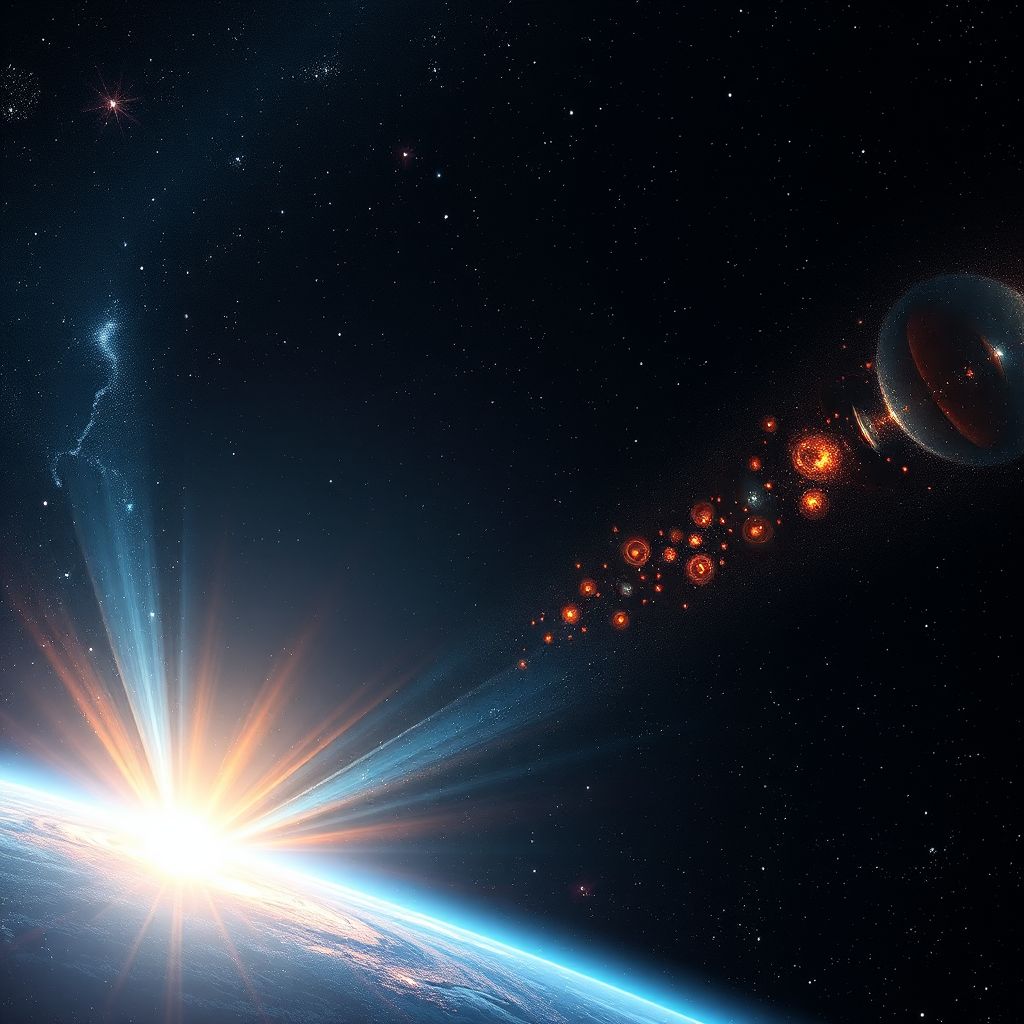
Understanding the origins of our universe is one of humanity’s most profound quests. This journey takes us to the very edge of scientific inquiry, where concepts such as cosmic inflation and the Big Bang theory come into play. What Is Cosmic Inflation and the Big Bang? It’s a question that has puzzled scientists for decades and continues to shape our understanding of how the universe came to be.
- Introduction: What Is Cosmic Inflation and the Big Bang?
- The Birth of the Universe: The Big Bang Theory
- Theoretical Foundations of Cosmology
- Cosmic Inflation Explained
- The Role of Dark Energy in the Universe’s Expansion
- Observational Evidence for Cosmic Inflation and the Big Bang
- Challenges and Controversies Surrounding Cosmic Inflation Theory
- Implications of Cosmic Inflation on Modern Cosmology
- Conclusion: A Glimpse into the Future of Cosmic Research
Introduction: What Is Cosmic Inflation and the Big Bang?
The Big Bang theory is a cornerstone in cosmology, explaining how the universe began from an incredibly hot, dense state roughly 13.8 billion years ago. This event marked the beginning of cosmic expansion, leading to the formation of galaxies, stars, planets, and life as we know it.
What Is Cosmic Inflation?, a period shortly after the Big Bang during which space rapidly expanded at an incredible rate. This phase laid the foundation for the universe’s current large-scale structure and uniformity across vast cosmic distances.
The Birth of the Universe: The Big Bang Theory
The Big Bang theory posits that around 13.8 billion years ago, our universe began as a point of infinite density and temperature known as a singularity. From this singular state, the universe underwent an enormous expansion, leading to the cooling and formation of matter.
Pro Tip: The Expansion Continues
While we often think of the Big Bang as an explosion in space, it’s more accurate to envision it as a rapid expansion of space itself. This continuous expansion is still occurring today, with distant galaxies moving away from us at increasing speeds.
Cosmic Inflation Explained
Cosmic inflation theory was proposed by physicist Alan Guth in the early 1980s to address some of the limitations and peculiarities observed in the standard Big Bang model. According to this theory, just a fraction of a second after the initial singularity, the universe underwent an extremely rapid exponential expansion.
Pro Tip: The Scale Factor
The scale factor is a key concept in understanding cosmic inflation. During this period, the scale factor increased exponentially, causing distances to expand at an accelerating rate and smoothing out any irregularities in density that could lead to non-uniform distribution of matter.
The Role of Dark Energy in the Universe’s Expansion
Dark energy is a mysterious force driving the accelerated expansion of the universe, discovered through observations made by the Supernova Cosmology Project and High-Z Supernova Search Team. This phenomenon further complicates our understanding of cosmic inflation.
Pro Tip: Dark Energy vs. Inflation
While both dark energy and cosmic inflation contribute to the expansion of space, they operate on different scales and timescales. Cosmic inflation occurred in the early universe, whereas dark energy is currently driving the acceleration of this expansion.
Observational Evidence for Cosmic Inflation and the Big Bang
The cosmic microwave background (CMB) radiation provides strong evidence supporting both the Big Bang theory and cosmic inflation. This ancient light, first detected in 1964 by Arno Penzias and Robert Wilson, offers a snapshot of the universe shortly after its birth.
Pro Tip: CMB Anisotropies
The slight temperature variations in the CMB provide crucial insights into the early conditions of the universe. These anisotropies are consistent with predictions made by inflationary models, indicating that cosmic inflation indeed occurred shortly after the Big Bang.
Challenges and Controversies Surrounding Cosmic Inflation Theory
Despite its success in explaining many observed phenomena, cosmic inflation is not without controversy. Some physicists argue that certain aspects of the theory are too speculative or lack direct empirical support.
Pro Tip: String Theory Connections
Some researchers suggest connections between cosmic inflation and string theory, proposing that higher-dimensional structures could explain fine-tuning issues within inflationary models. However, these ideas remain highly theoretical.
Implications of Cosmic Inflation on Modern Cosmology
Cosmic inflation has far-reaching implications for modern cosmological research, influencing areas such as dark matter studies and the exploration of alternative theories to general relativity. It also opens doors to new experimental avenues in particle physics.
Pro Tip: Multiverse Hypotheses
The concept of a multiverse arises naturally from certain inflationary models, suggesting that our universe might be just one among countless others with varying physical laws and constants. This hypothesis challenges traditional notions of cosmology but remains speculative without concrete observational evidence.
Conclusion: A Glimpse into the Future of Cosmic Research
The quest to understand What Is Cosmic Inflation and the Big Bang? continues to drive scientific inquiry, pushing boundaries in physics and cosmology. As we delve deeper into these mysteries, advancements in technology and observational techniques promise new insights that could redefine our understanding of the cosmos.

- OrginCosmic
- Interstellar Probes and the Future of Space Exploration March 27, 2026
- How Supernovae Shape Galaxy Evolution March 27, 2026
- Unexplained Transient Astronomical Events March 27, 2026
- The Role of Dark Energy in Cosmic Evolution March 27, 2026
- Vacuum Decay: A Doomsday Scenario for the Universe? March 27, 2026