What Happens Inside a Black Hole?
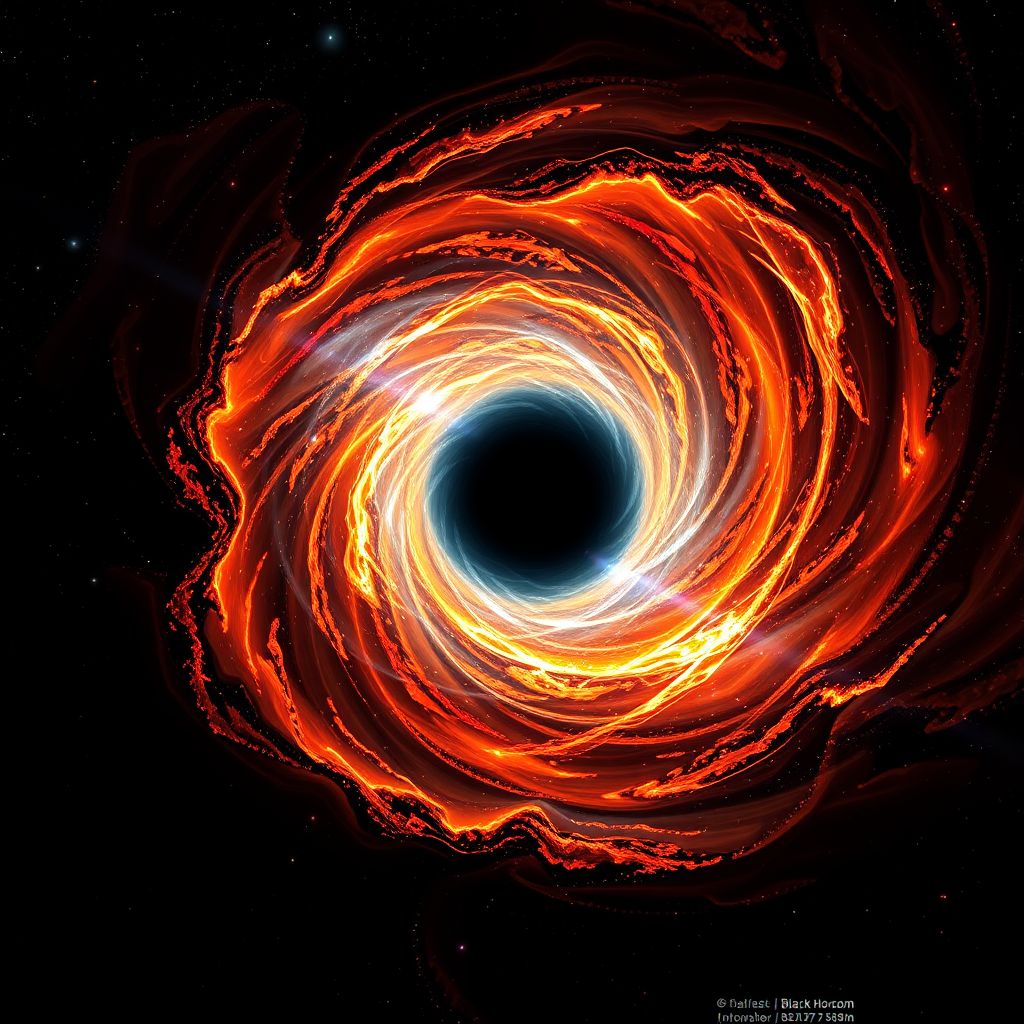
What happens inside a black hole has long been a subject of fascination for scientists and space enthusiasts alike. These mysterious cosmic entities are regions in space where gravity is so strong that not even light can escape, making them both a challenge and an opportunity for astrophysical research. Understanding what happens inside a black hole? could provide insights into the fundamental nature of our universe, including concepts like time, matter, and energy.
- Introduction to Black Holes
- The Event Horizon: The Point of No Return
- Formation and Types of Black Holes
- Inside the Singularity: A Region of Infinite Density?
- The Role of General Relativity in Understanding Black Holes
- Black Hole Evaporation: Theoretical Concepts and Realities
- Observational Evidence of Black Holes
- Future Research Directions in Black Hole Studies
Introduction to Black Hholes
Black holes are regions in space where the gravitational pull is so strong that not even light can escape. This phenomenon was first predicted by Einstein’s general theory of relativity, and it challenges our understanding of physics as we know it. To truly comprehend what happens inside a black hole?, one must delve into the theoretical frameworks that govern these enigmatic objects.
The Event Horizon: The Point of No Return
The event horizon is the boundary around a black hole beyond which nothing can escape its gravitational pull. For an observer outside this boundary, time appears to slow down as they approach it. This slowing effect is due to the extreme curvature of spacetime caused by the immense gravity near the black hole’s center. As one crosses the event horizon, they would enter a realm where conventional physics breaks down.
Key Features of Event Horizons
- Diameter: The diameter of an event horizon is directly proportional to the mass of the black hole.
- Schwarzschild Radius: This is the radius at which a non-rotating black hole’s event horizon exists. It is named after Karl Schwarzschild, who first described it mathematically.
Formation and Types of Black Holes
Black holes form from the remnants of massive stars that have gone supernova. When a star’s core collapses under its own gravity, if it exceeds the Chandrasekhar limit (about 1.4 times the mass of our Sun), it will continue to collapse into a black hole. There are several types of black holes:
Stellar Black Holes
The most common type of black hole, these form from massive stars that have run out of fuel and collapsed.
Supermassive Black Holes
Located at the centers of galaxies, supermassive black holes can be millions to billions of times more massive than our Sun. They are thought to influence galaxy formation and evolution.
Inside the Singularity: A Region of Infinite Density?
The singularity is a point inside a black hole where all known laws of physics break down due to the extreme conditions. According to general relativity, as matter approaches this point, its density increases infinitely. However, quantum mechanics suggests that singularities might not exist in reality but could be resolved by quantum gravity theories.
Quantum Gravity Theories
Theories such as loop quantum gravity and string theory propose modifications to general relativity at the Planck scale (approximately 10^-35 meters) where quantum effects dominate over gravitational ones. These models aim to resolve the singularity problem by describing space-time in discrete units.
The Role of General Relativity in Understanding Black Holes
General relativity, Einstein’s theory of gravity, provides a framework for understanding black holes and their properties. It describes how mass curves spacetime, leading to the formation of singularities inside black holes. However, general relativity breaks down at these points, necessitating the need for quantum mechanics.
Challenges in Combining Theories
The unification of general relativity with quantum mechanics remains one of the biggest challenges in theoretical physics. Such a theory would be crucial for understanding phenomena inside black holes and resolving singularities.
Black Hole Evaporation: Theoretical Concepts and Realities
Stephen Hawking proposed that black holes emit radiation due to quantum effects near the event horizon, leading to their eventual evaporation over cosmic timescales. This process is known as Hawking radiation.
Hawking Radiation Mechanism
Hawking radiation arises from particle-antiparticle pairs created in the vacuum near a black hole’s event horizon. If one member of the pair falls into the black hole while the other escapes, it appears as if the black hole emits radiation.
Observational Evidence of Black Holes
Despite their elusive nature, several pieces of observational evidence support the existence and properties of black holes:
Emission Spectra from Accretion Disks
Astronomers observe unique spectral lines emitted by gas clouds orbiting near a black hole’s event horizon. These spectra provide indirect confirmation of black hole presence.
Future Research Directions in Black Hole Studies
Advancements in observational techniques and theoretical physics continue to shed light on the mysteries surrounding black holes. Future research aims at refining our understanding of their internal dynamics, resolving singularities, and exploring potential connections between black holes and other fundamental aspects of the universe.
Potential Discoveries
Upcoming missions like LISA (Laser Interferometer Space Antenna) will detect gravitational waves from merging supermassive black holes, providing unprecedented insights into their behavior.
In conclusion, understanding what happens inside a black hole? is an ongoing quest in modern astrophysics. It not only challenges our current theoretical frameworks but also promises to unlock deeper truths about the cosmos and the nature of reality itself.

- OrginCosmic
- Interstellar Probes and the Future of Space Exploration March 27, 2026
- How Supernovae Shape Galaxy Evolution March 27, 2026
- Unexplained Transient Astronomical Events March 27, 2026
- The Role of Dark Energy in Cosmic Evolution March 27, 2026
- Vacuum Decay: A Doomsday Scenario for the Universe? March 27, 2026