The Mysterious Nature of Dark Matter Explained
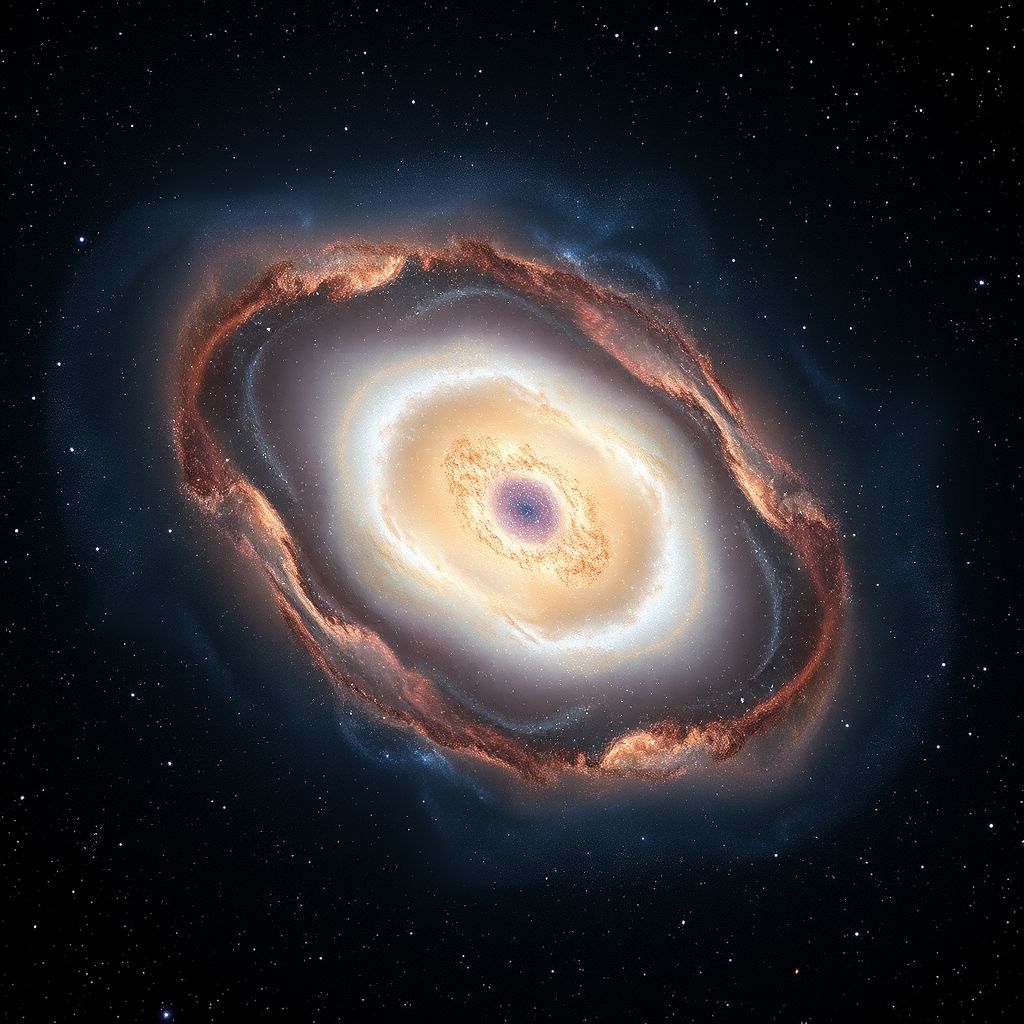
The universe’s most enigmatic component, dark matter, has long been a subject of intense scientific inquiry and speculation. Despite its name, which might suggest an absence or void, dark matter is actually a substantial part of our cosmos, making up approximately 27% of the known universe. Its mysterious nature presents one of the greatest challenges in astrophysics today. This article delves into The Mysterious Nature of Dark Matter Explained, examining its properties, origins, and implications for cosmology.
Table of Contents
- What is Dark Matter?
- The Discovery of Dark Matter
- Properties and Characteristics of Dark Matter
- Detection Methods for Dark Matter
- Implications of Dark Matter in Cosmology
- Theoretical Models and Hypotheses on Dark Matter
- Current Research and Future Prospects
The Mysterious Nature of Dark Matter Explained: What is Dark Matter?
Dark matter is a form of matter distinct from the ordinary matter that makes up stars, planets, and all visible objects in the universe. It does not emit or absorb electromagnetic radiation such as light, radio waves, X-rays, etc., which means it cannot be detected through traditional astronomical observations.
Properties of Dark Matter
Dark matter exhibits several unique properties that distinguish it from ordinary matter:
- Non-luminous: It does not emit, absorb, or reflect light.
- Penetrating: It can pass through solid objects without interacting with them.
- Gravitational Influence: Dark matter interacts with ordinary matter and other dark matter only via gravity.
The Discovery of Dark Matter
The existence of dark matter was first hypothesized by Swiss astrophysicist Fritz Zwicky in the 1930s. While studying galaxy clusters, he noticed that the visible mass of galaxies did not account for their observed rotational speeds and gravitational forces. He concluded there must be an invisible form of matter providing the necessary gravity to hold these clusters together.
Key Observations Leading to Dark Matter
- Galaxy Rotation Curves: Galaxies rotate too fast at their edges for the amount of visible mass present. This implies that there is additional unseen matter exerting gravitational force.
- Gravitational Lensing: Dark matter’s presence can be inferred from how it bends light from distant galaxies, causing a phenomenon known as weak lensing or strong lensing.
Properties and Characteristics of Dark Matter
The Mysterious Nature of Dark Matter Explained is further illuminated by understanding its various properties. One of the most striking aspects of dark matter is its gravitational influence on visible matter, which can be observed through large-scale structure formation in the universe.
Gravitational Influence
Dark matter’s gravity plays a crucial role in shaping the cosmos. Without it, galaxies would fly apart due to insufficient gravitational force from ordinary matter alone. Its influence is also evident in the cosmic web structure of filaments and voids.
Detection Methods for Dark Matter
Given its elusive nature, detecting dark matter particles directly has proven challenging. However, scientists have devised several methods aimed at capturing evidence of these mysterious entities:
Direct Detection Experiments
LUX-ZEPLIN (LZ): This experiment aims to detect weakly interacting massive particles (WIMPs), a leading candidate for dark matter. LZ uses a large tank of liquid xenon placed deep underground to shield from cosmic rays and background radiation.
Implications of Dark Matter in Cosmology
The implications of dark matter extend far beyond mere existence; they impact our understanding of the universe’s evolution. For instance, simulations incorporating dark matter predict the formation of large-scale structures like galaxy clusters and superclusters.
Theoretical Models and Hypotheses on Dark Matter
Several theoretical models attempt to explain the nature of dark matter:
- WIMPs (Weakly Interacting Massive Particles): Proposed as a possible form of dark matter, WIMPs are believed to be stable and massive.
- Axions: These hypothetical particles could also make up a significant portion of the universe’s dark matter.
Current Research and Future Prospects
Ongoing research continues to probe deeper into the mysteries surrounding dark matter. Projects such as Origincosmic are at the forefront of these endeavors, exploring innovative detection methods and theoretical frameworks.
Future Directions in Dark Matter Research
The next decade promises significant advancements in our understanding of dark matter. With larger experimental setups and more sophisticated observational techniques, scientists hope to conclusively identify the nature of this elusive substance.
In summary, The Mysterious Nature of Dark Matter Explained reveals a complex interplay between gravity, particles, and cosmic structure formation that challenges conventional physics paradigms. Continued research will undoubtedly shed light on these mysteries, potentially rewriting our understanding of the cosmos.

- OrginCosmic
- Interstellar Probes and the Future of Space Exploration March 27, 2026
- How Supernovae Shape Galaxy Evolution March 27, 2026
- Unexplained Transient Astronomical Events March 27, 2026
- The Role of Dark Energy in Cosmic Evolution March 27, 2026
- Vacuum Decay: A Doomsday Scenario for the Universe? March 27, 2026