The Cosmic Web: How Galaxies Are Connected
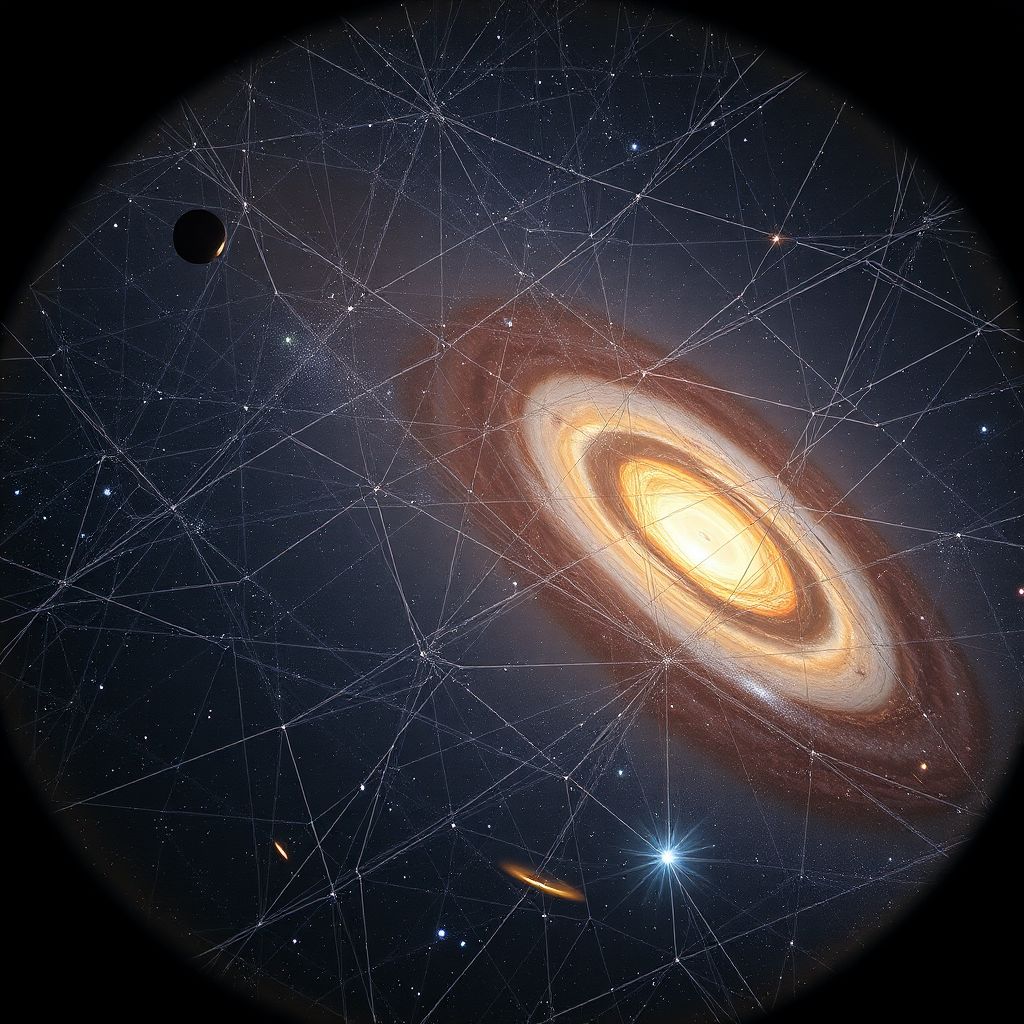
The universe is a vast expanse filled with countless galaxies, each a testament to the grandeur of cosmic evolution. The intricate connections between these celestial bodies form what astronomers refer to as “The Cosmic Web: How Galaxies Are Connected”. This complex network not only outlines how galaxies are interconnected but also reveals crucial insights into the structure and dynamics of our universe.
Understanding the Basics of Galaxy Connections
The cosmic web is a theoretical framework that describes the large-scale distribution of matter in the universe. It consists of filaments, nodes, and voids, which together make up an intricate network akin to spider webs or neural networks on Earth.
Filaments: The Cosmic Highway
At the heart of this cosmic architecture are the filaments. These elongated structures connect galaxy clusters and superclusters, serving as highways for matter flow in the universe. This network is not static; it evolves over time due to gravity and dark energy.
The Role of Dark Matter
Dark matter plays a crucial role in shaping the cosmic web. It forms the backbone of these intricate structures, guiding the formation and evolution of galaxies within its gravitational embrace.
Pro Tip: Observational Evidence
Recent observations from projects like the Dark Energy Survey (DES) provide compelling evidence for the existence of dark matter. These surveys use advanced techniques such as weak lensing to map the distribution of dark matter in the universe.
How Galaxies Form and Evolve
The cosmic web profoundly influences how galaxies form and evolve over billions of years. Through gravitational interactions, gas clouds condense into stars, leading to the birth of new galaxies within dense regions like nodes or clusters.
The Impact on Galaxy Morphology
As galaxies interact within this network, they can merge, collide, and rearrange their structures. This process significantly affects galaxy morphology, transitioning spiral galaxies into ellipticals over time.
Observational Techniques to Study the Cosmic Web
Scientists employ various observational techniques to study the cosmic web:
- Spectroscopy: Measures the velocities of galaxies and quantifies how they move relative to each other.
- Lensing Effects: Analyzes gravitational lensing caused by massive structures like clusters, revealing hidden dark matter distributions.
Advancements in Technology
Advancements such as the James Webb Space Telescope (JWST) are set to revolutionize our understanding of galaxy formation and evolution. These tools offer unprecedented resolution and sensitivity, allowing us to peer deeper into space than ever before.
Cosmic Web Models
Several models exist to describe the cosmic web, each with varying degrees of complexity:
- Spherical Collapse Model: Explains how overdense regions collapse under gravity, eventually forming galaxies.
- Zel’dovich Approximation: Provides a simplified approach to understanding initial conditions and the growth of structure in the early universe.
Current Research Efforts
Researchers are actively working on refining these models by incorporating more realistic physics, including star formation, feedback processes, and dark energy dynamics. This work is essential for predicting galaxy evolution accurately.
Implications of the Cosmic Web
The cosmic web has significant implications not only in astrophysics but also in cosmology:
- Understanding the distribution and growth of structure within it helps constrain parameters like the Hubble constant.
- Numerical simulations: Enable researchers to model complex phenomena, such as galaxy mergers and cluster formation.
The Future of Cosmic Web Studies
The future promises more detailed studies through upcoming missions like Euclid and WFIRST. These projects will provide critical data on the distribution of matter across cosmic time, helping to unravel mysteries surrounding dark energy and the ultimate fate of our universe.
Challenges in Studying the Cosmic Web
Despite its importance, studying the cosmic web presents numerous challenges:
- Data Complexity: Analyzing vast datasets from multiple observatories requires advanced computational techniques and algorithms.
- Theoretical Uncertainties: Certain aspects of dark matter behavior remain poorly understood, complicating model predictions.
Collaborative Efforts
To overcome these challenges, international collaborations are forming. These groups combine resources and expertise to tackle the multifaceted nature of cosmic web research effectively.
The Cosmic Web: A Window into Our Universe’s Evolution
The cosmic web offers a unique perspective on how our universe evolved from an early state of homogeneity to its current diverse structure. By studying this network, we can gain profound insights into the origins and future trajectory of galaxies.
Conclusion: Embrace the Intricacies
The complexity and beauty of “The Cosmic Web: How Galaxies Are Connected” highlight the interconnectedness within our cosmos. As technology advances, so too will our understanding of this cosmic tapestry, revealing new mysteries to explore.
- Understanding the Basics of Galaxy Connections
- The Role of Dark Matter
- How Galaxies Form and Evolve
- Observational Techniques to Study the Cosmic Web
- Cosmic Web Models
- Implications of the Cosmic Web
- Challenges in Studying the Cosmic Web
- The Cosmic Web: A Window into Our Universe’s Evolution
For more insights and advanced theories on cosmic structures, visit OriginCosmic.

- OrginCosmic
- Interstellar Probes and the Future of Space Exploration March 27, 2026
- How Supernovae Shape Galaxy Evolution March 27, 2026
- Unexplained Transient Astronomical Events March 27, 2026
- The Role of Dark Energy in Cosmic Evolution March 27, 2026
- Vacuum Decay: A Doomsday Scenario for the Universe? March 27, 2026