How Do Planets Form Around Young Stars?
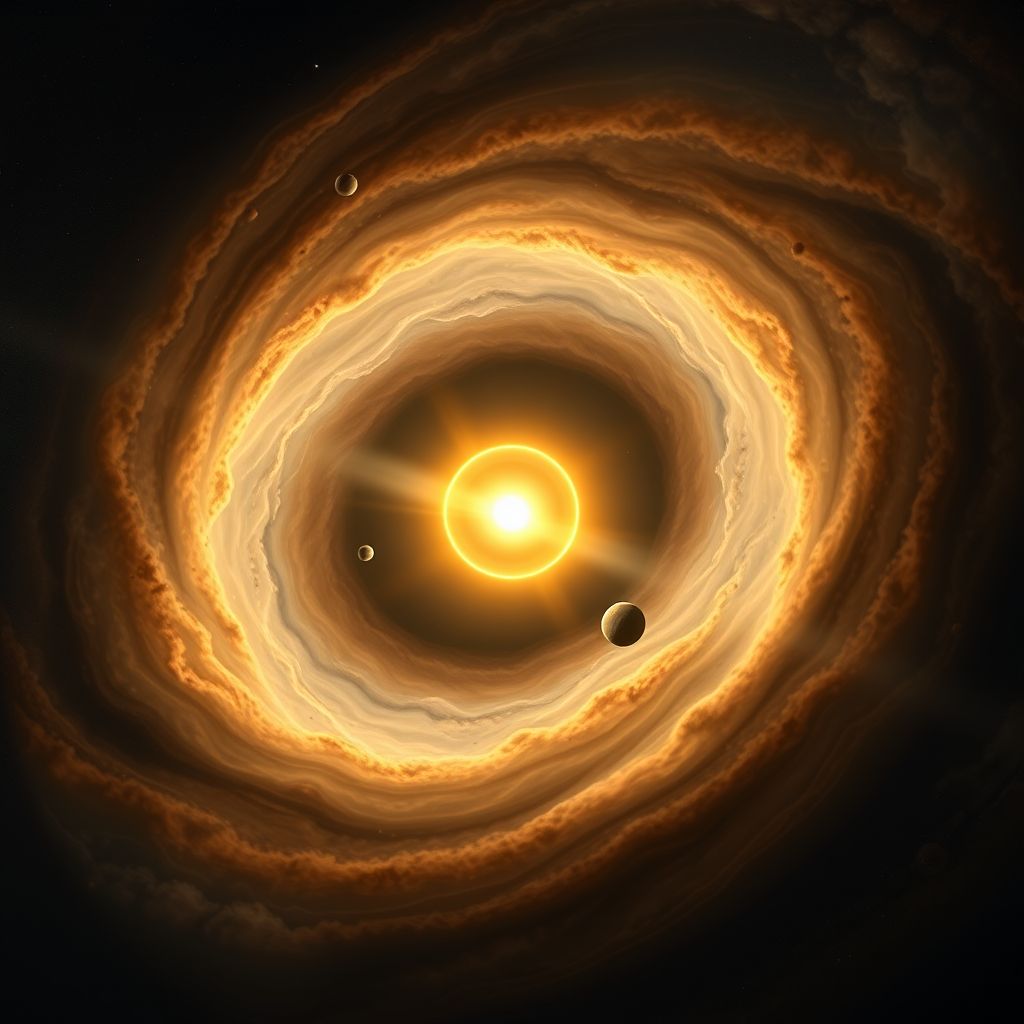
Understanding how do planets form around young stars? is one of the most fascinating areas in modern astrophysics, offering insights into our own solar system’s origins and potential planetary systems across the galaxy. This process involves intricate celestial mechanics that scientists are still unraveling today. From the initial stages of star formation to the complex dynamics governing planet accretion, this article delves deep into the mechanisms behind planetary creation.
- The Basics: What is Planetary Formation?
- Star Formation and Protostellar Disks
- Dust and Gas in the Early Solar System
- Gravitational Instability and Planetesimal Formation
- Planet Migration and Orbital Dynamics
- Observing Planetary Systems: Recent Discoveries
- Theories on Earth’s Formation: A Closer Look
The Basics: What is Planetary Formation?
The question of how do planets form around young stars? has puzzled scientists for decades. Planetary formation begins with the collapse of interstellar clouds, leading to the birth of a star and the creation of a protoplanetary disk surrounding it. This process involves complex interactions between gas, dust, and gravity, which ultimately lead to the assembly of planetary bodies.
Pro Tip: Understanding the basics of stellar evolution provides crucial context for exploring how planets form around young stars.
Star Formation and Protostellar Disks
The journey of star formation starts with a giant molecular cloud, a cold nebula composed primarily of hydrogen gas and dust. When triggered by external forces such as shock waves from nearby supernovae or the gravity of passing stars, this cloud collapses under its own weight.
- Cloud Fragmentation: As the cloud begins to compress, it fragments into smaller clumps due to gravitational instability. Each fragment may eventually evolve into a protostar.
- Collapse and Rotation: These clumps start rotating faster as they collapse, forming a flattened disk of material around each protostar known as a protoplanetary disk.
Dust and Gas in the Early Solar System
The protoplanetary disks are composed primarily of gas (mainly hydrogen) and dust particles. Over time, these elements interact through collisions, sticking together to form larger aggregates called planetesimals.
- Grain Growth: Dust grains collide and stick together, growing in size over millions of years.
- Dust Settling: As dust settles toward the mid-plane of the disk, it creates a denser layer where planetesimal formation can occur.
Gravitational Instability and Planetesimal Formation
Once dust grains have grown sufficiently large to resist sublimation in warmer parts of the disk, they start agglomerating into larger bodies called planetesimals. These objects are crucial for building planets through collisions and mergers.
- Nebular Instability: In some regions of the disk where density is high enough, gravitational instabilities may cause localized collapses leading to direct formation of planet-sized objects.
Planet Migration and Orbital Dynamics
Planets do not always remain in their initial orbits; many undergo migration due to interactions with the protoplanetary disk. This can lead to a variety of outcomes, including orbital resonances and planet collisions.
- Type I Migration: Due to differential rotation between planets and the disk material, low-mass planets experience inward or outward migration depending on their size and location in the disk.
- Type II Migration: Larger planets can open gaps in the disk, causing them to migrate more rapidly and dramatically.
Observing Planetary Systems: Recent Discoveries
Astronomers have made significant strides in observing young stellar systems using a variety of techniques. For instance:
- Direct Imaging: With advancements in technology, scientists can directly image protoplanetary disks and candidate planets around nearby stars.
- Spectroscopy: By analyzing the light spectrum emitted or absorbed by celestial bodies, researchers gain insights into their composition and dynamics.
Theories on Earth’s Formation: A Closer Look
The study of how do planets form around young stars? also sheds light on our own planet. The solar nebula hypothesis explains the formation of our Sun and its accompanying planets, including Earth.
- Solar Nebula Theory: According to this theory, a rotating cloud of gas and dust contracted under gravity to form the Sun, while the remaining material flattened into a disk where the planets formed through accretion.
- Volatile Depletion Zones: Earth’s proximity to the Sun caused early depletion of volatiles like water vapor during its formation, leading to its dry composition compared to gas giants further out in the solar system.
The exploration of how do planets form around young stars? continues to be a vibrant field with ongoing research and discoveries. As we uncover more about these processes, our understanding of planetary systems across the universe expands significantly. This knowledge not only enhances our appreciation for Earth but also opens avenues for studying exoplanets and their habitability.
For further insights into stellar formation and related topics, visit Origin Cosmic.
Conclusion: Key Takeaways on Planetary Formation
The process of how do planets form around young stars? is a multi-faceted journey involving star and disk formation, dust aggregation into planetesimals, gravitational interactions leading to planetary migration, and direct observation of nascent systems. Each step illuminates our understanding of cosmic evolution and reinforces the interconnectedness of celestial mechanics across different scales.
Future studies will undoubtedly reveal new details about these mechanisms, enhancing our grasp of the myriad ways in which planets form throughout the cosmos.

- OrginCosmic
- Interstellar Probes and the Future of Space Exploration March 27, 2026
- How Supernovae Shape Galaxy Evolution March 27, 2026
- Unexplained Transient Astronomical Events March 27, 2026
- The Role of Dark Energy in Cosmic Evolution March 27, 2026
- Vacuum Decay: A Doomsday Scenario for the Universe? March 27, 2026