Gravitational Waves: Ripples in Space-Time
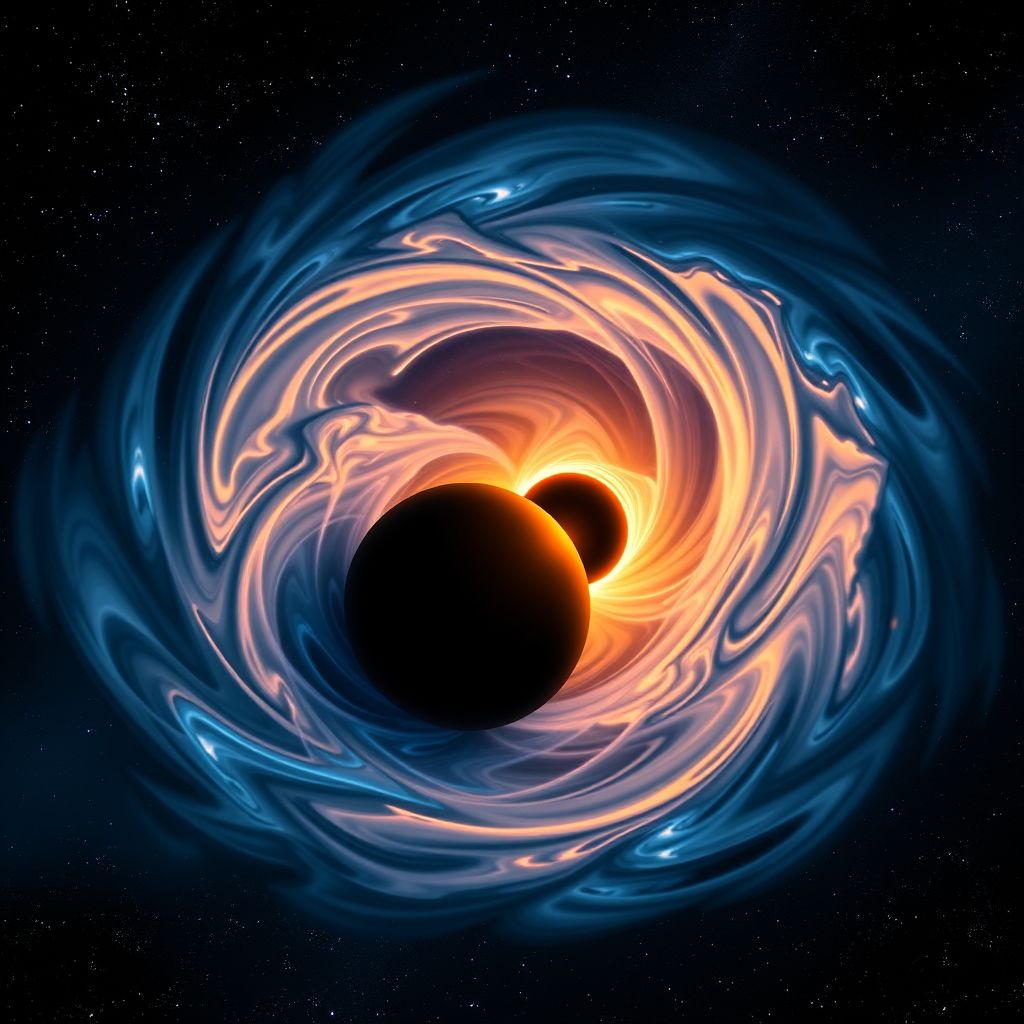
Gravitational waves: ripples in space-time are a fascinating aspect of modern physics that have been capturing the imagination of scientists and laypeople alike since their first detection by LIGO in 2015. These subtle distortions in the fabric of spacetime provide a unique window into some of the most extreme events in the universe, such as the collision of black holes or neutron stars. This article delves deep into the intricacies of gravitational waves: ripples in space-time, their detection methods, and what they can tell us about the cosmos.
- Gravitational Waves: Ripples in Space-Time
- The Theory of General Relativity
- Detecting Gravitational Waves: LIGO and Beyond
- Applications of Gravitational Wave Astronomy
- Challenges in Gravitational Wave Detection
- Future Prospects and Research Directions
- Conclusion: The Impact of Gravitational Waves: Ripples in Space-Time on Science and Society
Gravitational Waves: Ripples in Space-Time
The concept of gravitational waves: ripples in space-time was first introduced by Albert Einstein as part of his theory of general relativity. According to this groundbreaking theory, massive objects such as stars and black holes can cause spacetime itself to curve or warp. When these massive objects accelerate, they generate disturbances in the fabric of spacetime that propagate outward at the speed of light. These disturbances are known as gravitational waves: ripples in space-time.
Understanding Gravitational Waves
The detection of gravitational waves represents a monumental breakthrough in our understanding of the universe. Unlike electromagnetic radiation, which can be absorbed or scattered by matter, gravitational waves pass through everything without interference, offering an unparalleled view into the cosmos. The amplitude and frequency of these ripples provide clues about the size, mass, and velocity of the celestial objects that generate them.
The Theory of General Relativity
To fully appreciate gravitational waves: ripples in space-time, it is essential to understand the framework within which they exist. Einstein’s theory of general relativity posits that gravity is not a force but rather a curvature of spacetime caused by mass and energy.
Mathematical Formulation
The equations governing this curvature are notoriously complex, making exact solutions difficult to obtain except for the simplest systems (e.g., isolated black holes or non-rotating spherical stars). However, these equations predict that any accelerating mass will produce gravitational radiation, a prediction confirmed by the observation of binary pulsars in 1974.
Detecting Gravitational Waves: LIGO and Beyond
The Laser Interferometer Gravitational-Wave Observatory (LIGO) is at the forefront of gravitational wave detection, featuring two massive interferometers located in Washington and Louisiana. Each detector consists of an “L”-shaped tube with arms 4 kilometers long.
LIGO’s Sensitivity
At its peak sensitivity, LIGO can detect changes in distance smaller than the diameter of a proton over distances of several kilometers. This remarkable feat is achieved through ultra-stable laser light and suspended mirrors that are isolated from environmental noise using advanced seismic isolation techniques.
Applications of Gravitational Wave Astronomy
The study of gravitational waves: ripples in space-time offers unprecedented opportunities for astrophysics. By analyzing the characteristics of detected signals, researchers can learn about the masses and spins of merging black holes or neutron stars.
Black Hole Mergers
A notable example occurred on September 14, 2015, when LIGO detected the first-ever gravitational waves: ripples in space-time from the collision of two black holes. This event, known as GW150914, marked a new era in astronomy.
Neutron Star Mergers
The merger of neutron stars on August 17, 62017 (GW170817) provided the first evidence for the existence of binary neutron star systems. It also offered insights into the origin of heavy elements like gold and platinum through a phenomenon known as “kilonovae.”
Dark Matter and Dark Energy
The indirect effects of gravitational waves can help us probe mysteries such as dark matter and dark energy, which together make up around 95% of the universe’s mass-energy content. Indirect measurements could reveal how these components affect spacetime curvature.
Challenges in Gravitational Wave Detection
The road to detecting gravitational waves: ripples in space-time has been fraught with technical challenges and setbacks. One major obstacle lies in minimizing noise from the environment, which can mask the tiny signals of passing gravitational waves.
Noise Reduction Techniques
Scientists employ advanced techniques such as active seismic isolation systems to shield detectors from ground vibrations caused by human activity or natural phenomena like earthquakes. However, even with these measures, residual environmental noise remains a significant challenge in improving detection sensitivity.
Future Prospects and Research Directions
The field of gravitational wave astronomy is poised for rapid growth and expansion. Upgrades to existing detectors like LIGO will enhance their capabilities further, while new observatories are being planned worldwide to increase coverage across the globe.
Global Collaboration
International cooperation plays a crucial role in advancing this research area. Projects such as Europe’s Virgo interferometer and Japan’s KAGRA contribute valuable data to global efforts. By combining signals from multiple detectors, scientists can better locate sources of gravitational waves: ripples in space-time and study their properties.
Conclusion: The Impact of Gravitational Waves: Ripples in Space-Time on Science and Society
The discovery of gravitational waves: ripples in space-time has opened up a new era in astronomy, providing unique insights into the most extreme phenomena in our universe. These subtle distortions offer us an unobstructed view into events that were previously shrouded in mystery.
From unraveling the nature of black holes to understanding cosmic explosions and even probing the mysteries of dark matter and energy, gravitational wave astronomy promises to revolutionize not only physics but also our broader perception of reality. As technology continues to advance, we can expect many more groundbreaking discoveries that will deepen our comprehension of space-time itself.

- OrginCosmic
- Interstellar Probes and the Future of Space Exploration March 27, 2026
- How Supernovae Shape Galaxy Evolution March 27, 2026
- Unexplained Transient Astronomical Events March 27, 2026
- The Role of Dark Energy in Cosmic Evolution March 27, 2026
- Vacuum Decay: A Doomsday Scenario for the Universe? March 27, 2026