Gamma-Ray Bursts: The Most Powerful Explosions in Space
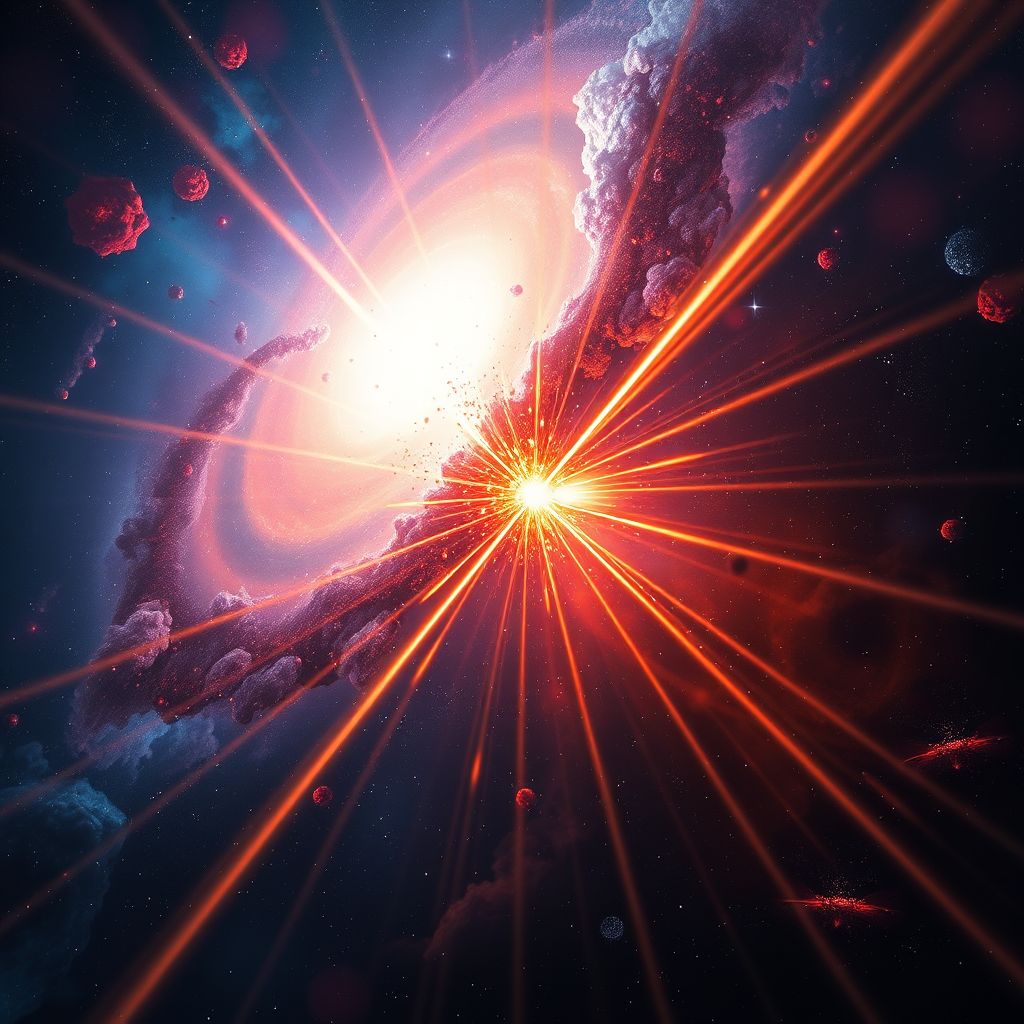
Gamma-Ray Bursts: The Most Powerful Explosions in Space are cosmic phenomena that have captivated scientists since their discovery in the 1960s. These brief but intense flashes of gamma-ray light appear randomly across the sky and have been linked to some of the most energetic events known in the universe, such as supernovae and hypernovae. Understanding Gamma-Ray Bursts is crucial for unraveling the mysteries of cosmic evolution and high-energy astrophysics.
- Introduction to Gamma-Ray Bursts: The Most Powerful Explosions in Space
- History and Discovery of Gamma-Ray Bursts
- The Mechanics Behind Gamma-Ray Bursts
- Types of Gamma-Ray Bursts
- Observations and Data Collection Techniques for Gamma-Ray Bursts
- Impact on Astronomy and Astrophysics Research
- Future Prospects and Challenges in Studying Gamma-Ray Bursts
- Conclusion: Understanding the Mysteries of Space Through Gamma-Ray Bursts
Introduction to Gamma-Ray Bursts: The Most Powerful Explosions in Space
The study of Gamma-Ray Bursts (GRBs) offers a unique window into the high-energy universe. These bursts, which can last from a few milliseconds to several minutes, are thought to originate from violent cosmic events such as the collapse of massive stars or collisions between neutron stars. The energy released in just one GRB is comparable to that emitted by our Sun over its entire 10-billion-year lifetime. This makes them not only fascinating but also crucial for understanding extreme astrophysical processes.
History and Discovery of Gamma-Ray Bursts
The story of GRBs begins in the Cold War era, when satellites designed to detect gamma rays from potential nuclear tests discovered unexpected cosmic signals. The first confirmed GRB was detected on July 2, 1967, by a Vela satellite. Initially classified as top-secret military data, these bursts were later declassified and led to extensive research in astrophysics. Today, numerous space observatories dedicated to studying GRBs, such as NASA’s Swift Observatory and the Fermi Gamma-ray Space Telescope, continue to gather valuable data.
Key Observations from Early Research
The initial observations of GRBs provided researchers with a plethora of questions but few answers. One of the earliest breakthroughs came in 1997 when a burst was associated with an optical counterpart, allowing for the first measurement of its distance and confirming that these events occur at cosmological distances.
The Mechanics Behind Gamma-Ray Bursts
Understanding the mechanics behind GRBs involves intricate astrophysical processes. The prevailing theory suggests that long-duration GRBs are produced by massive stars collapsing into black holes, a process known as core-collapse supernovae. These events release an enormous amount of energy in a narrow beam of gamma rays, which can be observed on Earth only if the beam happens to point toward us.
Short-Duration Gamma-Ray Bursts
In contrast, short-duration GRBs are thought to result from the merger of two neutron stars or a neutron star and a black hole. These mergers produce less intense but still incredibly powerful bursts that are detectable at great distances.
Types of Gamma-Ray Bursts
GRBs can be broadly classified into two categories: long-duration (lasting more than 2 seconds) and short-duration (less than 2 seconds). Long-duration GRBs are typically associated with the collapse of massive stars, while short-duration bursts are believed to originate from compact object mergers.
Long-Duration Gamma-Ray Bursts
These events are characterized by their prolonged emission and often come with a faint afterglow detectable in other wavelengths. They provide valuable insights into the lifecycle of massive stars and the formation of black holes.
Observations and Data Collection Techniques for Gamma-Ray Bursts
The study of GRBs relies heavily on sophisticated observational techniques that include ground-based telescopes, space observatories, and networks like Swift. These instruments enable scientists to capture the transient nature of GRBs across multiple wavelengths.
Multi-Wavelength Observations
Observing GRBs in different electromagnetic bands helps researchers understand their full energy spectrum and evolution over time. For example, detecting an X-ray afterglow shortly after a burst can help pinpoint its location and study its immediate environment.
Impact on Astronomy and Astrophysics Research
The discovery of GRBs has had profound implications for astronomy and astrophysics. They serve as beacons for some of the most energetic events in the universe, providing a way to study distant galaxies and star-forming regions that would otherwise be invisible.
GRBs and Cosmology
The detection of GRBs at cosmological distances has allowed astronomers to use them as standard candles for measuring cosmic expansion. This helps in refining estimates of the age and geometry of the universe.
Future Prospects and Challenges in Studying Gamma-Ray Bursts
The future of GRB research holds great promise with new missions like OriginCosmic’s Space Missions, which aim to provide higher resolution data and broader wavelength coverage. However, challenges remain in understanding the exact mechanisms behind different types of bursts and improving real-time detection capabilities.
Technological Advancements
Innovations such as faster data processing speeds and more sensitive detectors will be key to overcoming these challenges and unlocking new insights into cosmic phenomena like GRBs.
Conclusion: Understanding the Mysteries of Space Through Gamma-Ray Bursts
The study of Gamma-Ray Bursts continues to unravel some of the deepest mysteries in astrophysics. By exploring these powerful explosions, we gain a clearer picture not only of extreme cosmic events but also of the underlying physics governing our universe’s most energetic processes.

- OrginCosmic
- Interstellar Probes and the Future of Space Exploration March 27, 2026
- How Supernovae Shape Galaxy Evolution March 27, 2026
- Unexplained Transient Astronomical Events March 27, 2026
- The Role of Dark Energy in Cosmic Evolution March 27, 2026
- Vacuum Decay: A Doomsday Scenario for the Universe? March 27, 2026