Exploring the Origins of the Universe: From Nothing to Everything
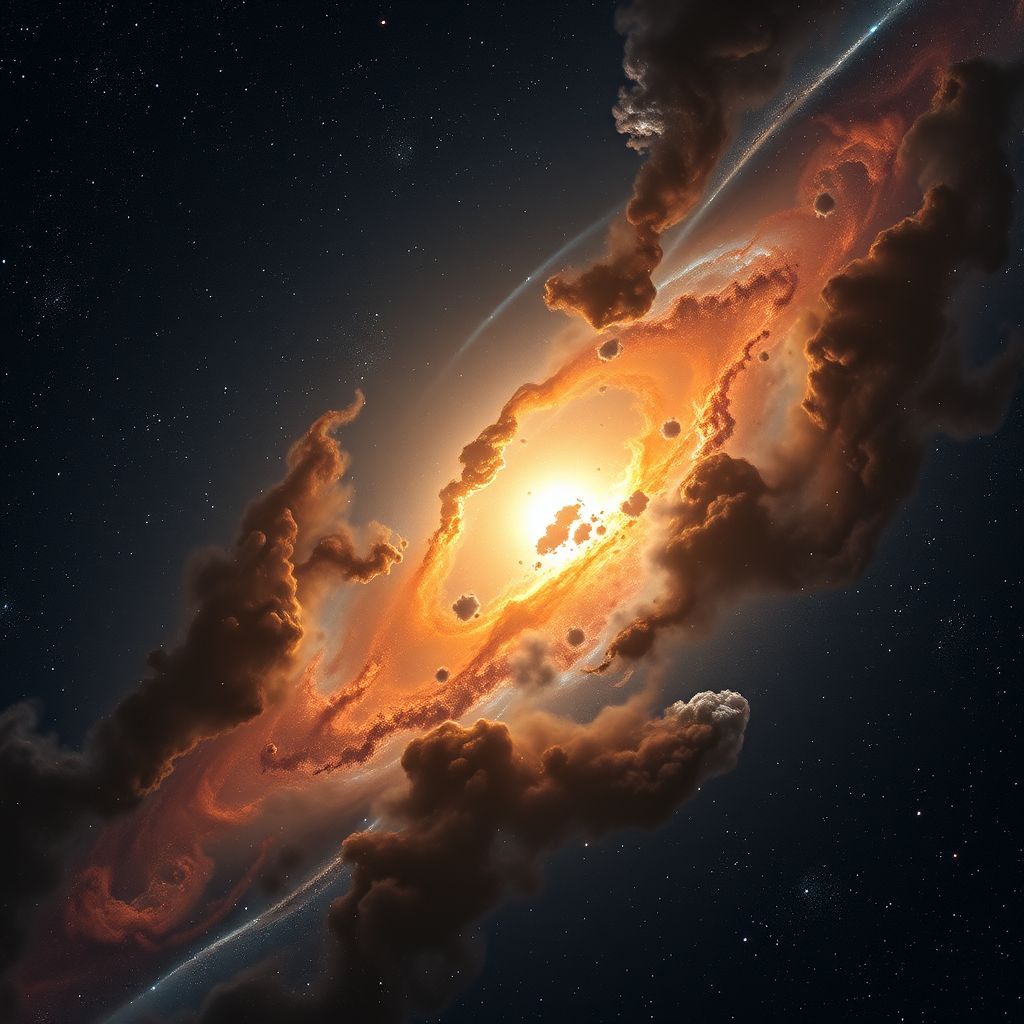
Exploring the Origins of the Universe: From Nothing to Everything is a captivating journey that delves into the deepest questions about existence itself. This article aims to unravel the mysteries behind the Big Bang, cosmic inflation, and the expansion of space-time, offering insights from leading physicists and cosmologists around the world.
- The Concept of Nothingness
- Understanding Quantum Mechanics in Relation to Origin
- Exploring the Origins of the Universe: From Nothing to Everything – The Big Bang Theory
- The Role of Cosmic Inflation in Early Universe Expansion
- Key Evidence Supporting Origin Theories
- Challenges and Controversies in Understanding the Origins
- Future Directions for Research on Cosmic Evolution
The Concept of Nothingness
The idea that the universe began from nothing seems paradoxical and counterintuitive. However, this concept is rooted in philosophical and scientific discussions about the nature of existence before the Big Bang. Theories such as the Copenhagen interpretation of quantum mechanics suggest that particles can spontaneously appear and disappear at a subatomic level due to fluctuations in energy. This phenomenon challenges our conventional understanding of ‘nothingness,’ implying that it might be an active, dynamic state rather than a static absence.
Quantum Vacuum Fluctuations
The concept of quantum vacuum or the ground state of the electromagnetic field suggests that empty space is not truly devoid of matter but contains virtual particles and fields that continuously pop in and out of existence. This notion supports the idea that ‘nothingness’ can give rise to something.
Understanding Quantum Mechanics in Relation to Origin
Quantum mechanics plays a pivotal role in explaining how the universe could have emerged from nothing. According to quantum field theory, all matter and energy are manifestations of underlying fields that permeate space-time. These fields can fluctuate, creating particles and forces that form the fabric of our cosmos.
The Heisenberg Uncertainty Principle
One cornerstone of quantum mechanics is the Heisenberg uncertainty principle, which asserts that it’s impossible to simultaneously know both the position and velocity of a particle with absolute precision. This fundamental limit on measurement has profound implications for understanding how particles might emerge from nothingness through energy fluctuations.
Exploring the Origins of the Universe: From Nothing to Everything – The Big Bang Theory
The Big Bang theory is one of the most widely accepted explanations for the origin and evolution of the universe. According to this model, the cosmos emerged approximately 13.8 billion years ago from an extremely hot and dense initial state that rapidly expanded and cooled over time.
Timeline of Cosmic Expansion
The timeline begins with the Planck epoch at around \(10^{-43}\) seconds after the Big Bang, followed by stages such as cosmic inflation, nucleosynthesis, recombination, structure formation, and galaxy evolution. Each phase is crucial in shaping the universe we observe today.
The Role of Cosmic Inflation in Early Universe Expansion
Cosmic inflation is a hypothetical period of exponential expansion that occurred shortly after the Big Bang. This rapid growth smoothed out any irregularities and created conditions conducive to the formation of galaxies, stars, and planets.
Observational Evidence for Inflation
The cosmic microwave background radiation (CMB) provides strong evidence for inflation through its uniform temperature across vast regions of space. Additionally, tiny fluctuations in the CMB reveal subtle patterns that align with predictions made by theories supporting cosmic inflation.
Key Evidence Supporting Origin Theories
The Big Bang and other origin theories are supported by a wealth of observational evidence gathered from various sources. For instance, measurements of the redshift in distant galaxies confirm that our universe is expanding continuously at an accelerating rate.
Redshift Measurements
By analyzing how light from distant stars shifts towards longer wavelengths (red), scientists can infer that these objects are moving away from us at high speeds. This phenomenon, known as redshift, provides direct evidence of the universe’s expansion and supports the Big Bang model.
Challenges and Controversies in Understanding the Origins
Despite significant progress, numerous challenges remain in comprehending the origins of our cosmos. For example, reconciling quantum mechanics with general relativity remains a major obstacle towards developing a unified theory of everything.
The Quantum Gravity Problem
Scientists face difficulties when trying to apply principles of quantum mechanics to large-scale structures governed by gravity, leading to inconsistencies and mathematical singularities in existing theories. Solving this problem could provide deeper insights into how the universe began from nothingness.
Future Directions for Research on Cosmic Evolution
Ongoing research aims to refine our understanding of cosmic origins through advancements in observational technology, theoretical modeling, and experimental techniques. Efforts focus on probing dark matter, dark energy, and other enigmatic components that shape the universe.
The Search for Dark Matter
Experiments like those conducted at CERN’s Large Hadron Collider (LHC) aim to detect particles of dark matter, which constitutes about 27% of the universe’s mass-energy content. Discovering these elusive entities could shed light on fundamental aspects of cosmic evolution.
The journey of Exploring the Origins of the Universe: From Nothing to Everything continues as scientists push the boundaries of knowledge and technology to unravel more mysteries about our cosmos’s beginnings. As new discoveries emerge, we may come closer to understanding how everything arose from nothingness.

- OrginCosmic
- Interstellar Probes and the Future of Space Exploration March 27, 2026
- How Supernovae Shape Galaxy Evolution March 27, 2026
- Unexplained Transient Astronomical Events March 27, 2026
- The Role of Dark Energy in Cosmic Evolution March 27, 2026
- Vacuum Decay: A Doomsday Scenario for the Universe? March 27, 2026