Hot Jupiters: Giant Planets Orbiting Too Close to Stars
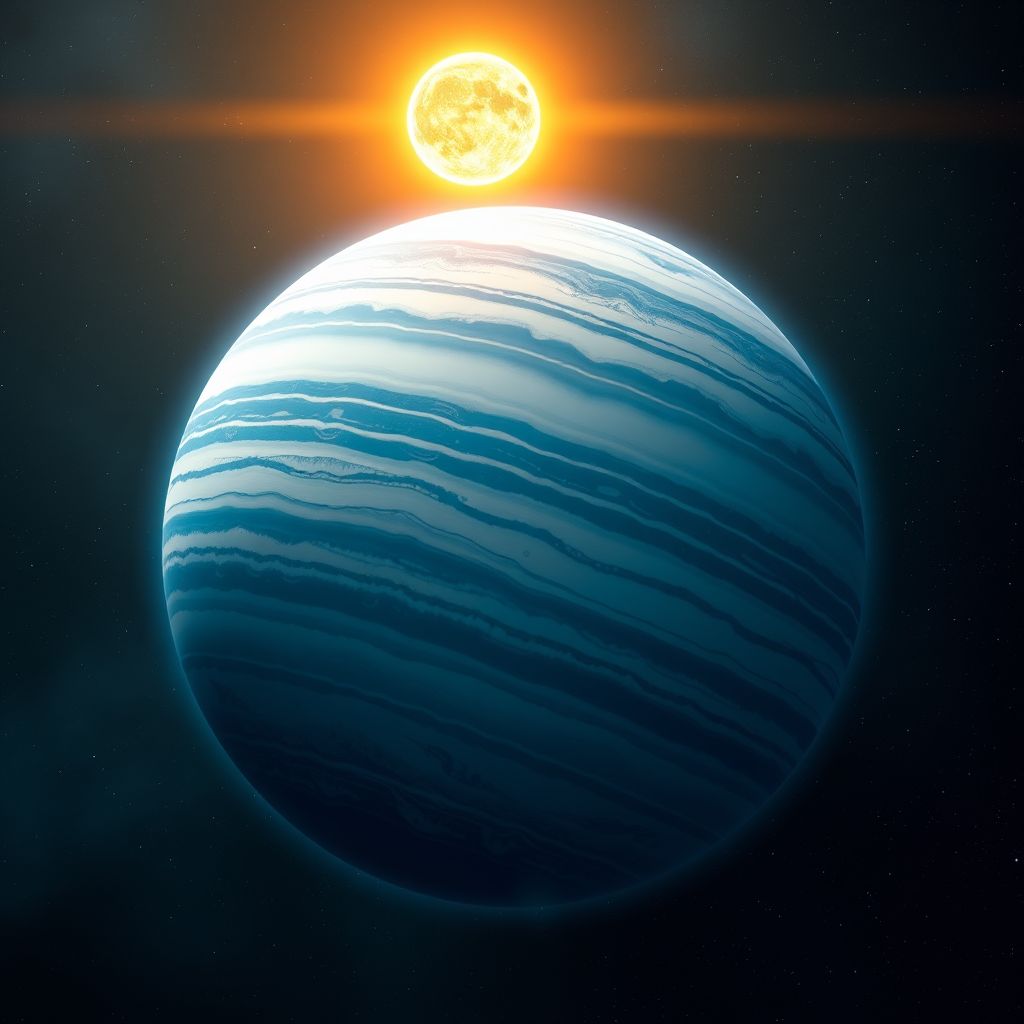
Hot Jupiters: Giant Planets Orbiting Too Close to Stars represent a fascinating subset of exoplanetary systems that continue to captivate astronomers and astrophysicists worldwide. These colossal planets, similar in size to Jupiter but with orbits perilously close to their host stars, challenge our understanding of planetary formation and dynamics. This article delves into the intricacies of Hot Jupiters, exploring their characteristics, origins, and implications for astrobiology.
- Introduction to Hot Jupiters: Giant Planets Orbiting Too Close to Stars
- Characteristics of Hot Jupiters
- Formation Theories for Hot Jupiters
- Impact on Planetary Systems
- Observation Techniques and Discoveries
- Astrobiological Implications of Hot Jupiters
- Future Research Directions for Studying Hot Jupiters
- Conclusion: Key Takeaways from the Study of Hot Jupiters
Introduction to Hot Jupiters: Giant Planets Orbiting Too Close to Stars
The term “Hot Jupiter” was coined by Duncan Forgan, an astronomer at the University of Edinburgh, to describe exoplanets that are similar in size and mass to Jupiter but orbit their stars at a distance of less than 0.1 astronomical units (AU), making them extremely hot due to proximity to their suns. These planets exhibit unique characteristics and behaviors that challenge traditional theories about planetary formation, migration, and evolution.
Characteristics of Hot Jupiters
The defining feature of Hot Jupiters: Giant Planets Orbiting Too Close to Stars is their proximity to the host star, leading to intense stellar radiation and extreme surface temperatures ranging from 1000 to 3000 Kelvin. Despite these harsh conditions, some Hot Jupiters exhibit strong magnetic fields and complex atmospheric dynamics, including super-rotation and tidal locking. The high-energy environment can lead to significant mass loss through evaporation, forming a massive tail-like structure called an exospheric envelope around the planet.
Atmospheric Composition
The atmospheres of Hot Jupiters are rich in hydrogen and helium, with traces of heavier elements such as carbon monoxide and water vapor. Observations have shown that some Hot Jupiters experience strong atmospheric winds and intense weather phenomena. These conditions can lead to the formation of distinct layers within their atmospheres, similar to stratification seen on Earth.
Magnetic Fields
The magnetic fields of Hot Jupiters are significantly influenced by their proximity to the star. The intense stellar radiation can induce strong currents in the planet’s interior, generating powerful magnetic fields that protect the planet from solar winds and cosmic rays. These magnetic fields play a crucial role in shaping the exospheric envelope and regulating atmospheric escape.
Formation Theories for Hot Jupiters
The formation of Hot Jupiters: Giant Planets Orbiting Too Close to Stars remains a subject of intense debate among astrophysicists. One leading theory suggests that these planets initially form in the outer regions of their planetary systems and then migrate inward through gravitational interactions with other bodies. Another hypothesis proposes that Hot Jupiters form directly within the hot inner region of protoplanetary disks, challenging traditional formation models.
Migration Theory
The migration theory posits that gas giants initially form in cooler regions far from their stars and then migrate inward due to gravitational interactions with disk material or other planets. This process can be driven by tidal forces, resonant trapping, or planetesimal scattering.
Direct Formation Theory
The direct formation theory suggests that Hot Jupiters form in situ within the innermost regions of protoplanetary disks. This model requires a high accretion rate and significant initial conditions to allow for rapid growth under extreme temperatures.
Impact on Planetary Systems
The presence of Hot Jupiters has profound effects on their planetary systems, influencing the dynamics and architecture of other bodies. These planets can disrupt the orbits of smaller, rocky worlds in close proximity, potentially leading to the ejection or collision of these bodies.
Orbital Instability
The gravitational pull of Hot Jupiters can cause significant orbital instability among nearby planets. This can result in complex resonances and chaotic dynamics, making long-term predictions difficult.
Tidal Effects
Tidal forces exerted by the star on the Hot Jupiter can lead to tidal locking, where one side of the planet always faces the star. This results in extreme temperature gradients and atmospheric circulation patterns that are unique to these systems.
Observation Techniques and Discoveries
The detection of Hot Jupiters: Giant Planets Orbiting Too Close to Stars has been made possible through various observational techniques, including the transit method and radial velocity measurements. The transit method involves observing the dimming of a star as a planet passes in front of it. Radial velocity observations measure the wobble induced by a planet’s gravitational pull on its star.
The Transit Method
The transit method has been particularly successful in identifying Hot Jupiters due to their large size and close proximity to their stars. The transits create detectable dips in the light curve of the host star, allowing for precise measurements of planetary parameters.
Radial Velocity Technique
The radial velocity technique involves detecting changes in a star’s motion caused by the gravitational pull of an orbiting planet. This method is less dependent on orientation and can provide information about planet masses and orbital periods.
Astrobiological Implications of Hot Jupiters
While Hot Jupiters: Giant Planets Orbiting Too Close to Stars are unlikely to host life as we know it due to extreme conditions, their study provides critical insights into the broader range of planetary environments and the potential for habitability in different parts of the universe.
Habitability Zones
The presence of Hot Jupiters can influence the location and stability of habitable zones within a star system. Understanding these dynamics is crucial for identifying potentially habitable planets around other stars.
Planetary Diversity
The study of Hot Jupiters underscores the diversity of planetary systems, highlighting that our solar system may not be typical. This insight has significant implications for astrobiology and the search for extraterrestrial life.
Future Research Directions for Studying Hot Jupiters
Ongoing research aims to refine observational techniques, explore new theoretical models, and integrate findings from different disciplines. Future missions will focus on characterizing the atmospheres of Hot Jupiters in greater detail, providing insights into their composition and structure.
New Observational Techniques
Advances in technology are enabling more precise measurements of planetary properties. Upcoming telescopes like the James Webb Space Telescope (JWST) will play a crucial role in this research.
Theoretical Modeling
Improved computational models and simulations will help refine our understanding of Hot Jupiter formation and evolution, potentially leading to new discoveries and hypotheses.
Conclusion: Key Takeaways from the Study of Hot Jupiters
The study of Hot Jupiters: Giant Planets Orbiting Too Close to Stars continues to yield valuable insights into planetary formation and dynamics. These planets challenge traditional theories, push the boundaries of observational techniques, and provide unique perspectives on the diversity of exoplanetary systems. As our understanding deepens, so too does our appreciation for the intricate and complex nature of the cosmos.

- OrginCosmic
- Interstellar Probes and the Future of Space Exploration March 27, 2026
- How Supernovae Shape Galaxy Evolution March 27, 2026
- Unexplained Transient Astronomical Events March 27, 2026
- The Role of Dark Energy in Cosmic Evolution March 27, 2026
- Vacuum Decay: A Doomsday Scenario for the Universe? March 27, 2026