Could Life Survive Inside Gas Giants’ Moons?
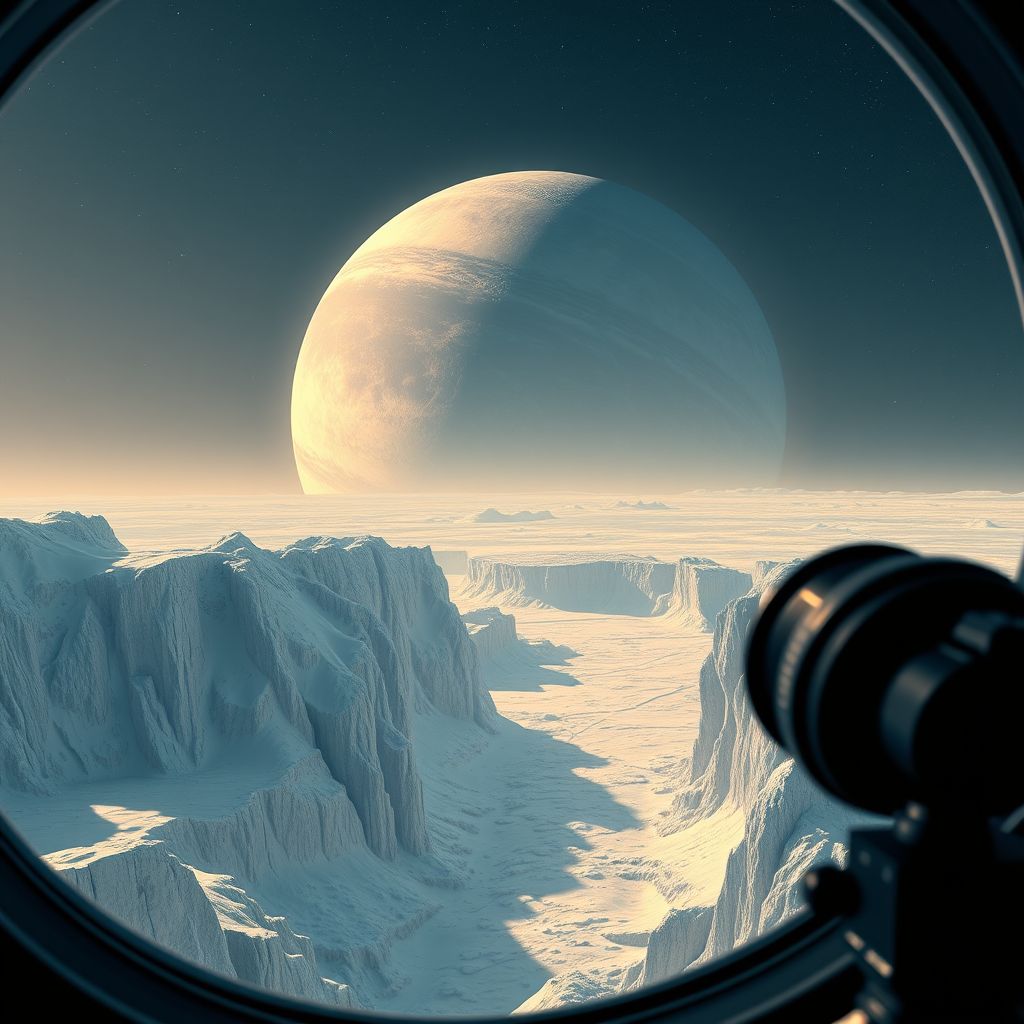
The enigmatic possibility of extraterrestrial life has captivated humanity for decades. Could Life Survive Inside Gas Giants’ Moons? This question delves into the fascinating realm where astrobiology meets planetary science, exploring environments far beyond our terrestrial understanding. The moons orbiting Jupiter and Saturn, in particular, have become focal points due to their unique characteristics that may support life as we know it or perhaps even forms of life that thrive under radically different conditions.
Could Life Survive Inside Gas Giants’ Moons?
The concept of life existing within the moons circling gas giants like Jupiter and Saturn is not merely a speculative idea but one grounded in scientific inquiry. The primary focus lies on celestial bodies such as Europa, Ganymede, Callisto, and Enceladus due to their potential to harbor liquid water beneath icy surfaces—a key ingredient for known life forms.
- Could Life Survive Inside Gas Giants’ Moons?
- The Habitability Factors of Gas Giant Moons
- Exploring Europa and Its Subsurface Ocean
- Ganymede: The Largest Moon in the Solar System
- Callisto’s Potential for Life-Sustaining Environments
- Enceladus and Its Plumes of Water Ice
- Future Missions to Investigate Gas Giant Moons
- The Challenges in Detecting Life Beyond Earth
The Habitability Factors of Gas Giant Moons
The study of potential habitable zones around gas giant moons involves several critical factors. The presence of liquid water is paramount, as it acts as a medium for biochemical reactions and supports various life forms on Earth. Additionally, energy sources are necessary to power biological processes, such as chemical gradients found in hydrothermal vents.
Temperature Ranges
The temperature ranges within these moons must be conducive to the existence of liquid water beneath their icy shells. Europa, for instance, has an estimated average surface temperature of -160°C (-256°F), yet its subsurface ocean remains liquid due to tidal heating caused by Jupiter’s gravitational pull.
Geological Activity
Geological activity plays a significant role in creating environments that can sustain life. Moons like Europa exhibit signs of tectonic movements and cryovolcanism, which suggest active processes capable of maintaining conditions favorable for life.
Exploring Europa and Its Subsurface Ocean
Europa is one of the most promising candidates in our quest to find extraterrestrial life. The moon’s surface is covered with an icy crust, beneath which lies a vast ocean estimated to be 100 kilometers thick. This subsurface ocean could harbor hydrothermal vents similar to those found on Earth’s ocean floors.
Evidence of Liquid Water
Scientists have identified several lines of evidence indicating the presence of liquid water beneath Europa’s ice. Spectral analysis reveals a smooth surface indicative of a thin layer of frost, suggesting active interaction between the subsurface ocean and the icy crust.
Ganymede: The Largest Moon in the Solar System
With a diameter greater than that of the planet Mercury, Ganymede is not only Jupiter’s largest moon but also the largest moon in our solar system. It has its own magnetic field and possesses vast amounts of water ice on its surface.
Magnetic Field Characteristics
Ganymede’s intrinsic magnetic field is unique among moons, likely generated by a molten iron core similar to Earth’s dynamo. This feature could provide clues about the moon’s interior structure and potential for geological activity.
Callisto’s Potential for Life-Sustaining Environments
Callisto offers another intriguing possibility in the search for extraterrestrial life, despite being one of Jupiter’s most distant moons. Its surface is heavily cratered and appears to be largely unchanged since its formation.
Surface Composition and Craters
The moon’s composition includes water ice mixed with silicate rock. The presence of craters provides insight into Callisto’s geological history, suggesting periods of intense bombardment followed by stable conditions.
Enceladus and Its Plumes of Water Ice
Among Saturn’s moons, Enceladus stands out due to its geologically active surface marked by numerous fissures spewing plumes of water vapor and ice particles into space. These observations indicate a subsurface ocean beneath the moon’s icy crust.
Plume Composition Analysis
Analysis of Enceladus’ plumes has revealed organic compounds, hydrogen gas, and other chemicals that could serve as energy sources for life forms. This discovery underscores the potential for habitable conditions within its subsurface ocean.
Future Missions to Investigate Gas Giant Moons
Several upcoming space missions are planned specifically to explore these moons and search for signs of life. NASA’s Europa Clipper, scheduled for launch in the mid-2020s, will conduct detailed observations from orbit around Jupiter’s moon.
Instrumentation and Scientific Objectives
The mission aims to map Europa’s surface composition, study its magnetic field, and analyze plumes of water vapor ejected from the subsurface ocean. Such data could provide crucial insights into the habitability of this enigmatic moon.
The Challenges in Detecting Life Beyond Earth
The search for life beyond our planet faces numerous challenges, including the limitations imposed by current technology and the inherent difficulties in identifying bio-signatures from a distance. However, advancements in astrobiology continue to push boundaries.
Technological Limitations
Current space missions rely on remote sensing techniques which, while powerful, have their limits when it comes to detecting microscopic life forms or organic compounds with high specificity. Future technologies may overcome these hurdles and offer more precise detection methods.
Conclusion: Unveiling Secrets of Gas Giant Moons
The exploration of moons orbiting gas giants like Jupiter and Saturn holds the promise of uncovering profound insights into extraterrestrial life. While challenges remain, ongoing research and planned missions are steadily advancing our understanding of these distant worlds.

- OrginCosmic
- Interstellar Probes and the Future of Space Exploration March 27, 2026
- How Supernovae Shape Galaxy Evolution March 27, 2026
- Unexplained Transient Astronomical Events March 27, 2026
- The Role of Dark Energy in Cosmic Evolution March 27, 2026
- Vacuum Decay: A Doomsday Scenario for the Universe? March 27, 2026